Lindsay Clancy's Defense Team Argues Insanity, Not Strangulation, for Children's Killing
-
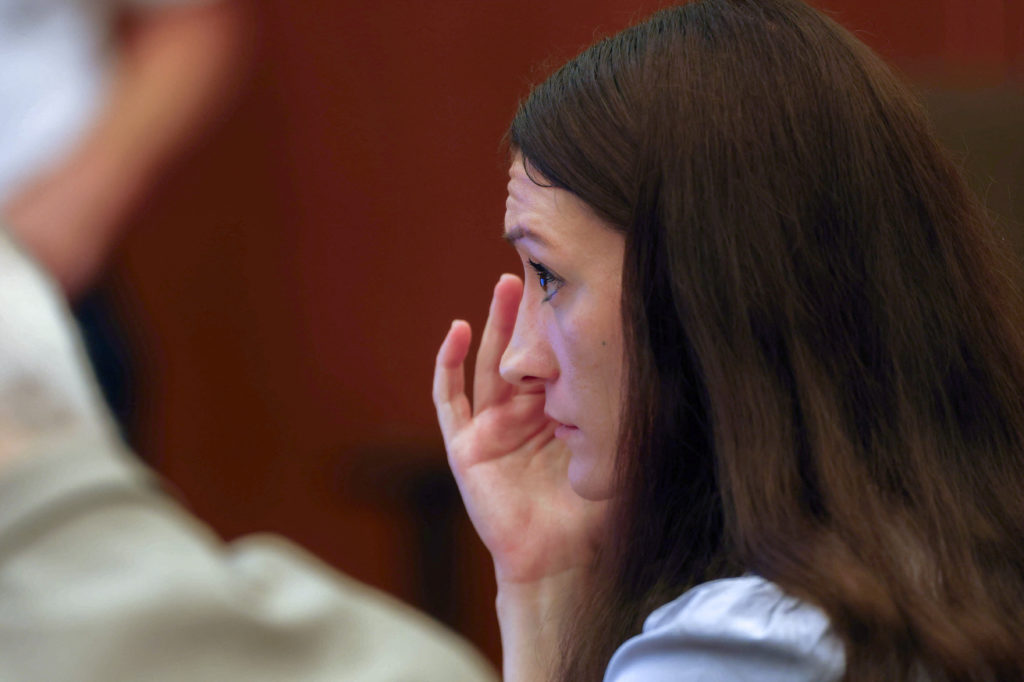
The defense has not argued that Clancy did not strangle her three young children, but has instead argued that she is not criminally responsible for the killings by reason of insanity. Clancy, the defense says, was suffering from severe postpartum psychosis — made worse by a series of mood-altering medications — at the time of the killings.
Compare 7 other versions
Washington ExaminerClancy’s defense attorneys don’t dispute that she murdered her children, but claim she shouldn’t be held criminally responsible due to reasons of mental illness. She faces up to life in prison if found guilty, and if found not guilty by reasons of insanity, she will be put in a state mental health institution.
PBS NewsHourMom and sister testify about Lindsay Clancy's declining mental state before she killed her children Clancy's mother and sister recounted how they saw her become increasingly anxious, paranoid and suicidal in the months before she killed her three children.
USA TodayClancy's defense argues that she is not guilty because she lacks criminal responsibility, which is more commonly known as an insanity defense. Defense attorney Kevin Reddington says Clancy she was suffering from postpartum depression and psychosis at the time of the killings.
The AtlanticMassachusetts prosecutors have argued that Clancy acted rationally and with clear intent, noting that she seemed organized, reasonable, and communicative in the days leading up to the murders, according to witnesses. Clancy’s diary entries and help-seeking indicate that she knew that her desire to harm herself and others was wrong, yet on the day that she apparently intended to kill her children, Clancy asked her then-husband to run an errand that would keep him out of the house. But the symptoms of postpartum psychosis, like those of bipolar disorder and schizoaffective disorder, are known to involve sudden and dramatic fluctuations, meaning that Clancy’s moods and cognition could have changed rapidly in the run-up to the murders—in defiance of most legal tests of insanity.
Washington TimesPLYMOUTH, Mass. — Prosecutors have finished presenting their case in the emotionally charged trial of Lindsay Clancy, the Massachusetts mom who has admitted killing her three young children but blamed her actions on her failing mental health.
The FederalistThe children were 5, 3, and 8 months old at the time of their painful deaths. A rash of social media postings indicates Clancy is not the only dangerous psychopath roaming about. Numerous women have taken to their accounts to claim Clancy should not be held responsible and to accuse her husband of the murders. Clancy’s sympathizers have raised nearly $1 million as of this writing to defend a woman whose attorney admits she is a child murderer.
The Guardian USThe defense in the Lindsay Clancy filicide case called the defendant’s mother as one of its first witnesses Monday, after three weeks of prosecution evidence laid out, in often harrowing detail, events surrounding Clancy’s killing of her three children.
-
Prosecutors rest case against Lindsay Clancy. What they argued Plymouth County Assistant District Attorneys Shanan Buckingham and Jennifer Sprague rested the prosecution's case on Monday, Aug. 17 on the 14th day of testimony after calling more than 70 witnesses to the stand.
Compare 1 other version
Washington TimesThe prosecution rested its case Monday after three weeks of testimony. Clancy’s lawyer now gets his chance to call witnesses.
-
Lindsay’s defense is seeking to show she was suffering from a broad array of depressive symptoms, for which she had sought psychiatric help in the months leading up to the killing. Reddington argues the killings were driven by postpartum mental illness and not an intentional act, as prosecutors contend, followed by an insincere suicide attempt.
Compare 1 other version
USA TodayAlso that month, Lindsay was admitted to Massachusetts General Hospital for suicidal thoughts. She then went to a facility for specialized postpartum treatment, where she stayed for one day after doctors said that "the program wasn't right for her," Patrick testified.
-
Musgrove testified that her daughter became increasingly concerned that officials at her children’s school were becoming aware of her deteriorating mental state. She also recalled Clancy losing a significant amount of weight and becoming paranoid about things that did not appear logical to her family.
Compare 1 other version
The Guardian USMusgrove also disclosed that on one occasion her daughter had approached her and Lindsay’s former husband, Patrick Clancy, and said: “I want to tell you guys something”.
7 details only one outlet reported
Independent claims that didn't surface elsewhere in our corpus. Treat as supplementary — not corroborated across outlets.
-
01 Washington Examiner The fundraiser is called “The Musgrove Family Fund” and lists the beneficiaries as Mike and Paula Musgrove to make their support of their daughter easier, but the comments attached to donations almost unanimously understand it as a support fund for Lindsay Clancy. The fundraiser itself notes that it was established with the parents’ explicit knowledge and consent and that Clancy’s attorney, Kevin Reddington, is “aware of it,” implying the parents are at least partially paying for Clancy’s legal defense costs in the high-profile case.
-
02 USA Today The case has garnered extensive publicity between drawing attention to postpartum mental health and sparking widespread conspiracy theories.
-
03 The Atlantic Insanity defenses, which are premised on the idea that people are not fully blameworthy for criminal acts that could be seen as outside their control, have existed since ancient Greece and Rome and have been a feature of jurisprudence for hundreds of years. The legal definition of guilt typically requires both action and intention, which means committing a crime while in a reckless, negligent, purposeful, or knowing state of mind. An insanity plea is premised on the assumption that people who are insane at the time of their crimes do not have the capacity for criminal intent, so they cannot be considered entirely guilty.
-
04 The Guardian US Clancy, Musgrove testified to the court in Plymouth, Massachusetts, had asked if she could sleep in her mother’s bed and told her she felt the medication she had been prescribed for postpartum depression were “destroying” her mind.
-
05 Washington Times The defense, on cross-examination, argued that Clancy was overmedicated and demonstrated that her care was disjointed, with doctors not speaking to one another, conducting appointments with her over Zoom and not sharing their notes. Despite her efforts to seek treatment, the defense also showed she was discharged from one facility after a day and denied a higher level of care at another when she couldn’t show that she had a suicide plan.
-
06 The Federalist One stupid response to this from people who either have no experience with women, let alone pregnancy, or are mentally broken in some way is to claim some variant of “postpartum depression is fake.” It’s true that, as social rewards for playing the victim have risen in our Marxist culture, people have increasingly sought to label themselves whatever victim status they can claim, including adopting mental disorders.
-
07 The Daily Wire The effect of true crime on women’s psyches goes well beyond seeing conspiracies everywhere; the rot has seeped far deeper. The favorite pastime of millions of American women has become listening as someone recounts, often in graphic detail, the rape, murder, and abuse of real people. It is naive to believe that consuming a steady barrage of brutality as entertainment would not eventually shape both how women see the world and how they respond to the suffering of the people in it. True crime is not simply a mindless distraction; it transforms the worst moments of real families’ lives into serialized entertainment, complete with heroes, villains, plot twists, and fan theories. The danger is not merely that it poisons the mind; it also poisons the soul.
Fact Corroboration
Which sources independently confirm the same facts. Hover a claim to see its sources, or a source to see what it corroborates.
Coverage by Perspective
Source Similarity
Connections show how similarly each outlet covered this story. Thicker lines = more similar framing.
Sources (8)
- guardian
- atlantic
- pbs
- washtimes
- dailywire
- usatoday
- federalist
- washexaminer