Apple Unveils New Mac Mini and Mac Studio Chips, Boosts Performance
-
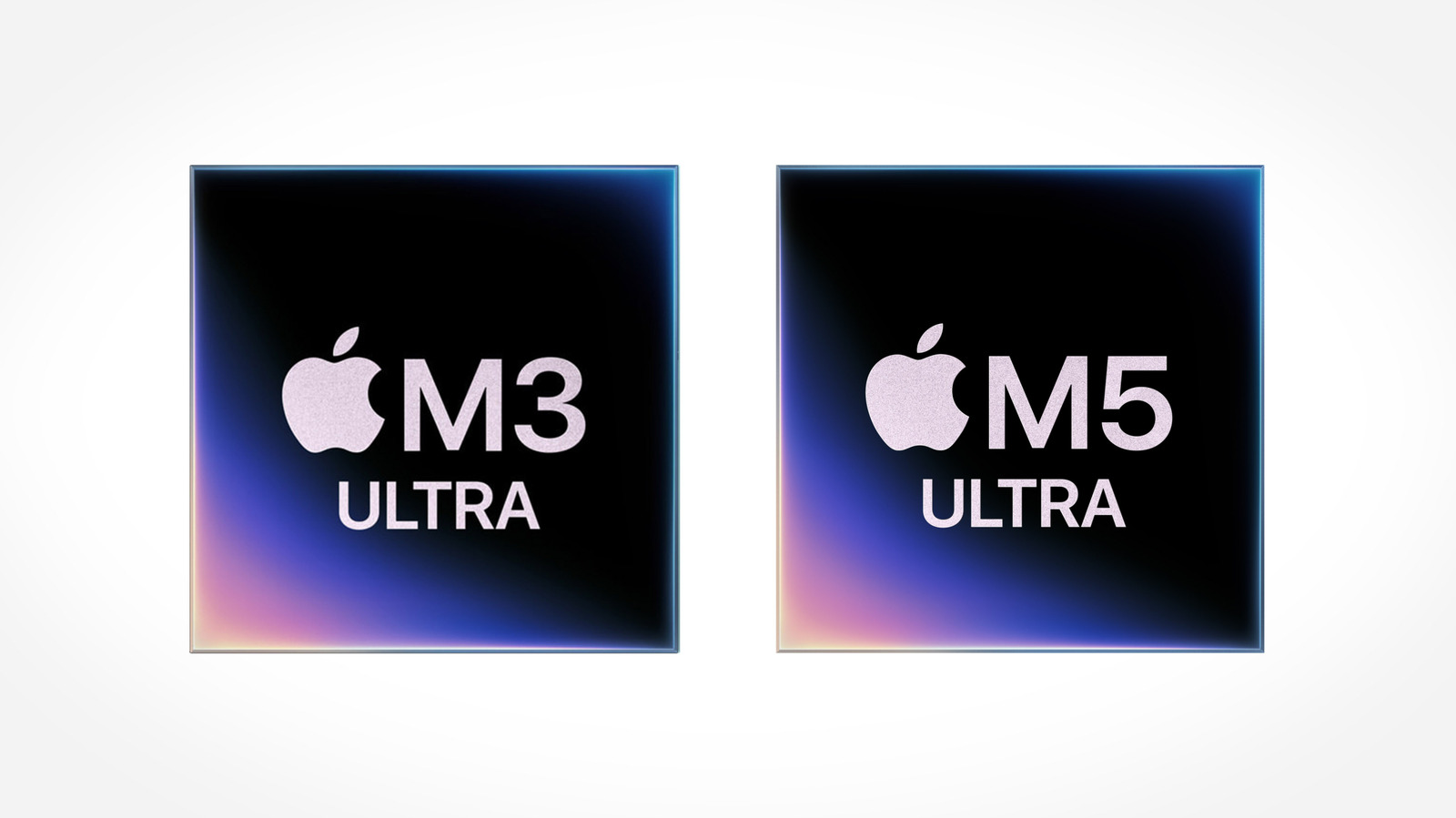
Apple announced on Tuesday a new range of chip configurations for its Mac Mini and Mac Studio desktop devices with the base M6 processor, M5 Max, and M5 Ultra chips. The latter is the company's most powerful chip to date, representing a new high-end processor tier with an 80-core GPU and four times faster LLM prompt performance compared to the M3 Ultra.
Compare 7 other versions
The VergeApple has announced a new M6 chip for Macs, along with an M5 Ultra that it says is its “most powerful chip ever,” designed for tasks like 3D rendering and running frontier AI models. The M6 is Apple’s first 2nm chip, which Apple says will bring improvements in performance and power efficiency, and it also has a Dual 16-core Neural Engine for on-device AI workloads.
CNETIn addition to launching a Mac Mini with a new M6 chip and Mac Studio with a new M5 Ultra, Apple brings its desktops into line with its MacBook Pro offerings, adding M5 Pro configurations for the Mini and M5 Max models for the Studio. Both the Mini and the Studio are identical to their predecessors physically: The performance and capabilities of the updated chips are the only changes.
Ars TechnicaToday, Apple announced new iterations of both desktops, along with two new chips: the M6, the first 2nm chip in Apple’s M-series lineup for Macs, and the M5 Ultra, now the most powerful chip in the lineup for most things—especially AI workloads.
EngadgetThe M5 Ultra can be configured with up to 36 CPU cores (12 super, 24 performance), delivering up to 25 percent faster single-threaded speeds than the M3 Ultra and 30 percent faster multi-threaded speeds, according to Apple. It can also be equipped with up to 80 (!) GPU cores, which offers up to 40 percent faster graphics than the M3 Ultra and a whopping 4.5X faster AI compute. It's no wonder the M5 Ultra Mac Studio starts at $5,499 — it's meant more for the likes of Pixar, not typical creatives.
GizmodoCompared to the previous-gen Mac Studio that peaked with an M3 Ultra chip, the new version with the M5 Ultra is the first time Apple is using a self-described “quad-die architecture.” Apple says it’s using new bridge technology it calls “UltraFusion” to connect two dual-die M5 Max chips together without any increased latency. That 4.4TB/s bandwidth connection between the two dies means that Apple can claim the M5 Ultra packs a peak 80-core GPU. To put that into perspective, the new M6 chip inside the new Mac mini is running a measly 12 cores.
WiredSkipping the M5 entirely, the Mac Mini now comes in two flavors: the M6 and the M5 Pro. The M5 Pro is the same chip that's currently found in the MacBook Pro, but the M6 is brand new. It's the first Apple Silicon part to be built on 2-nanometer process technology and also adds extra cores to the mix. This is a 12-core CPU—another first for Apple—broken down into two super cores, four performances cores, and six efficiency cores.
TechCrunchApple announced two new processors on Tuesday, which power its new Mac Mini and Mac Studio models: the M5 Ultra and M6 chips.
-
And upgrading the chips in a desktop is a lot simpler than in a laptop, where power consumption and heat dissipation are critical. So not tying the M6 release to potential MacBook announcements in October may have simply been a practical decision.
Compare 1 other version
ZDNetThe MacBook Pro with the M6 chip would keep the laptops on its regular upgrade cycle, aligning with its new device leasing program, and allocating its expensive processor components to specific devices ahead of time.
-
Up to 3.3x faster CopyCat ML training performance in Foundry Nuke when compared to Mac Studio with M3 Ultra. Up to 4x faster LLM prompt processing in LM Studio when compared to Mac Studio with M3 Ultra. Up to 4.3x faster text-to-image LLM performance when compared to Mac Studio with M3 Ultra. Up to 1.7x faster scene rendering performance in Maxon Redshift when compared to Mac Studio with M3 Ultra.
Compare 1 other version
GizmodoFor the sake of VFX artists or game designers who need a heavy-duty computer for rendering complex scenes, Apple says the new desktop should hit 1.7X faster rendering times in a program like Maxon Redshift than the M3 Ultra. However, the real boon for this new chip design is being held for people working with on-device AI. Apple promises this new “Ultra” chip can handle LLM (large language model) prompt processing 4X faster than an M3 Ultra.
7 details only one outlet reported
Independent claims that didn't surface elsewhere in our corpus. Treat as supplementary — not corroborated across outlets.
-
01 TechCrunch “With these frameworks and new chips, developers can run and fine-tune large AI models locally on their Mac,” Apple wrote in a press release. “Apple’s developer tools and frameworks automatically optimize performance across the CPU, GPU, and Neural Engine, and give developers the ability to use Apple Foundation Models, App Intents to tap into Apple Intelligence features, or their own proprietary AI models to build and run powerful AI workloads entirely on device.”
-
02 Engadget Here's how the company's most powerful chip ever stacks up with the previous generation.
-
03 Gizmodo Welp, according to Bloomberg’s Mark Gurman, Apple may have just taken a stab at reaching supply demand balance by plotting to release a surprise run of newly updated Mac Minis. As is often the case, Gurman’s reporting comes from “people familiar with the matter,” who “asked not to be identified because the plan isn’t public.”
-
04 Wired In a briefing on the Mac Studio, Apple even discussed the ability to connect multiple Mac Studios together over Thunderbolt 5 to run frontier-level LLMs with over a trillion parameters locally, allowing the four systems to share memory. Hypothetically, that allows you to run models locally on a Mac that just weren't possible before. Apparently, four Mac Studios can even be connected in this way to run over a standard wall outlet.
-
05 The Verge Apple just dropped a new polishing cloth, and unlike its refreshed Mac Mini models, it comes with a price cut, as spotted earlier by MacRumors. The polishing cloth is still “made with soft, nonabrasive material” but costs $9 instead of $19.
-
06 Ars Technica The Mac mini and Mac Studio occupy two distinct points in Apple’s lineup of desktops, but lately, they’ve had something in common: They’re popular for local AI inference and software development thanks to the advantages of their unified memory architecture and the fast CPUs and GPUs on their systems-on-a-chip.
-
07 CNET Not that the price increases come as a surprise. We’ve been going through a huge price shock, oversimplistically dubbed “RAMageddon,” thanks to ongoing component shortages. Semiconductor fab resources have been increasingly reallocated toward whatever’s ultimately the most profitable. Right now, that means anything critical to AI, notably data centers. And that pressure carries all the way down the supply chain, resulting in volatile prices for all other electronics.
Fact Corroboration
Which sources independently confirm the same facts. Hover a claim to see its sources, or a source to see what it corroborates.
Coverage by Perspective
Source Similarity
Connections show how similarly each outlet covered this story. Thicker lines = more similar framing.
Sources (8)
- verge
- cnet
- techcrunch
- gizmodo
- zdnet
- wired
- arstechnica
- engadget