WNBA Debates Transgender Participation Following Sophie Cunningham's Public Statements
-
There have been small rallies and protests outside Indiana Fever games after the issue came to a head when Sophie Cunningham of the Fever said in an ESPN profile published last month that she was opposed to transgender girls and women competing in girls’ and women’s sports. There are rallies planned before the Liberty face the Fever on Saturday night in Brooklyn.
Compare 3 other versions
VoxSpecifically, the league has found itself at the center of a debate over transgender athletes and women’s sports, one that Indiana Fever guard Sophie Cunningham ignited last month.
New York PostIndiana Fever guard Sophie Cunningham has been at the center of a firestorm since she spoke out in defense of women's and girls' sports. AP Photo/LM Otero
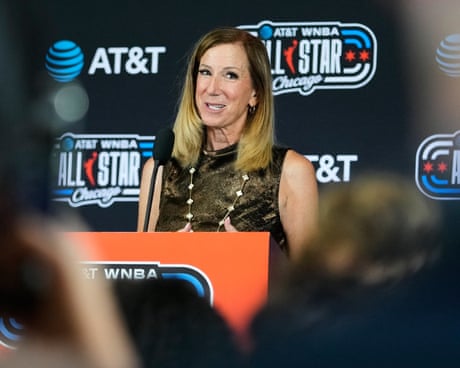
The Guardian USEngelbert made the comments on Thursday before the Indiana Fever’s loss to the Dallas Wings at the home of the Dallas Mavericks. Demonstrators showed up outside American Airlines Center, as they have at other venues since the Fever’s Sophie Cunningham voiced support for barring transgender girls and women from girls’ and women’s sports.
-
The WNBA has been the subject of recent debates on whether transgender women — people assigned male at birth who transition to align with their gender identity — should be allowed to participate in the league. There has never been such a player in the WNBA. Although the league’s collective bargaining agreement says the WNBA is restricted to women, it contains no more specific language about gender identity or sex assigned at birth.
Compare 3 other versions
The AtlanticThis is a snapshot of the current WNBA experience—unprecedented growth and great basketball at risk of being swallowed up by the same culture wars plaguing the broader political landscape. Nearly every day brings some new development conflating the conflicts. Last week, the former NBA players Royce White and Enes Kanter Freedom announced their intentions to identify as transgender in order to play in the WNBA. (It’s highly unlikely they’ll be allowed in the league.) During a game, Cunningham received a hard foul; the other player, the Chicago Sky’s DiJonai Carrington, was ejected and subsequently posted “WHITE PRIVILEGE” to social media.
VoxNo known trans athletes have ever played in the WNBA, but that hasn’t much deterred pundits from weighing in. It’s the latest instance of the WNBA playing a central role in conversations about race and gender — even as most of the outrage is happening outside the court, while players and coaches would rather focus on basketball.
The Guardian USThe league’s collective bargaining agreement states that “only players who are women are eligible to play in the WNBA,” but it does not include any more specific language about gender identity or sex assigned at birth. Earlier this month, two former NBA players, Enes Kanter Freedom and Royce White, declared themselves eligible for the WNBA draft, saying they identify as women.
-
Now coaches and players are being peppered with questions about where they stand—even though the league has never had a trans-woman player. (Layshia Clarendon, who was the first WNBA player to undergo top surgery, identified as nonbinary and trans. They retired in 2024.) Clark, too, has been criticized for not backing Cunningham’s stance. Some, like the Minnesota Lynx coach Cheryl Reeve, are choosing to do their own form of counterprotesting. Reeve wore a T-shirt during a recent game against the Fever that read Trans Kids Belong; ahead of the game, she defended trans rights to the media. “I’ve chosen to listen to transgender families, and what I know is exclusion is not the answer,” she said.
Compare 1 other version
The Guardian USSome WNBA players and coaches have come out in support of transgender athletes, including Seattle Storm center Stefanie Dolson and Minnesota Lynx coach Cheryl Reeve.
-
Cunningham, 30, has gained a reputation as an “enforcer” for her All-Star teammate, Caitlin Clark. In July, she told ESPN that “I think that I am here to extend love, but I also think that with love is truth, being honest. And I want to protect young girls in a locker room or young girls in sport who shouldn’t have to go against biological men.”
Compare 1 other version
The AtlanticAnd right before the All-Star Game, Clark’s teammate Sophie Cunningham told ESPN, “I want to protect young girls in a locker room, or young girls in sport who shouldn’t have to go against biological men,” which immediately became a massive talking point around and outside the league. Shortly thereafter, multiple rallies sprung up in support of Cunningham; Celeste Keaton, a co-owner of the Seattle Storm, was suspended after verbally confronting a pair of teenage fans during a game who were holding signs supporting Cunningham.
-
The WNBA, from the top down, has been understaffed, and it has historically been marketed in a way that is obsessed with trying to bring in some apocryphal average American, the nuclear family. And at the same time, this has been a league that has been defined by people who have historically existed on the margins. They are female athletes at a time when historically female athletes were not paid much attention to, and in fact were mocked.
Compare 1 other version
The AtlanticThis history has made the WNBA low-hanging fruit for MAGA figures, whether politicians or commentators, who use it to score cheap points with their base. Critics lacking a serious investment in women’s basketball can conveniently swoop in to recite their spiel, and pay no attention to the sport itself. When the league was less popular, its players may have been freer to express their opinions without blowback. Perhaps that’s no longer possible.
6 details only one outlet reported
Independent claims that didn't surface elsewhere in our corpus. Treat as supplementary — not corroborated across outlets.
-
01 New York Post The Tempo revealed Dez, a butch, non-binary Borealis Blue Snapping Turtle who uses she/they pronouns and “has a fondness for soft shell tacos,” the team said in an Tuesday announcement unveiling the new mascot.
-
02 Associated Press NEW YORK (AP) — New York Liberty star Breanna Stewart has always seen the WNBA as an inclusive place that has served as a safe space for both its fans and the players. That’s been challenged lately.
-
03 Breitbart The Log Cabin Republicans announced Thursday that it is dropping transgender advocacy and will now focus only on lesbian, gay, and bisexual issues.
-
04 The Guardian US The WNBA commissioner, Cathy Engelbert, has denounced people she said are trying to “sow divisiveness” as the league grapples with a debate over transgender athletes.
-
05 The Atlantic Let’s start with the good: The WNBA is more popular than ever. During the offseason, the league and the WNBA Players Association reached a landmark collective-bargaining agreement resulting in a 400 percent increase, on average, in player salaries. The average franchise valuation has soared 59 percent in the past year; the Golden State Valkyries were appraised at a league-high $850 million. Between now and 2030, the WNBA will add three new teams, in Cleveland, Detroit, and Philadelphia. And the WNBA saw a 44 percent jump in ratings for this year’s All-Star Game—which, for the first time ever, hosted more in-person fans than the NBA’s.
-
06 Vox On the court, the WNBA is thriving. After 30 years, its players are receiving a historic payout, along with a massive TV distribution deal that will mean more games, and hopefully even more fans. But off the court, all that attention has some downsides. Most recently, it means that the culture war has come for the WNBA.
Fact Corroboration
Which sources independently confirm the same facts. Hover a claim to see its sources, or a source to see what it corroborates.
Coverage by Perspective
Source Similarity
Connections show how similarly each outlet covered this story. Thicker lines = more similar framing.
Sources (6)
- nypost
- ap
- breitbart
- atlantic
- guardian
- vox