Canada Imposes 'Dollar-for-Dollar' Tariffs on U.S. Goods Amid Trade Breakdown with Trump
-
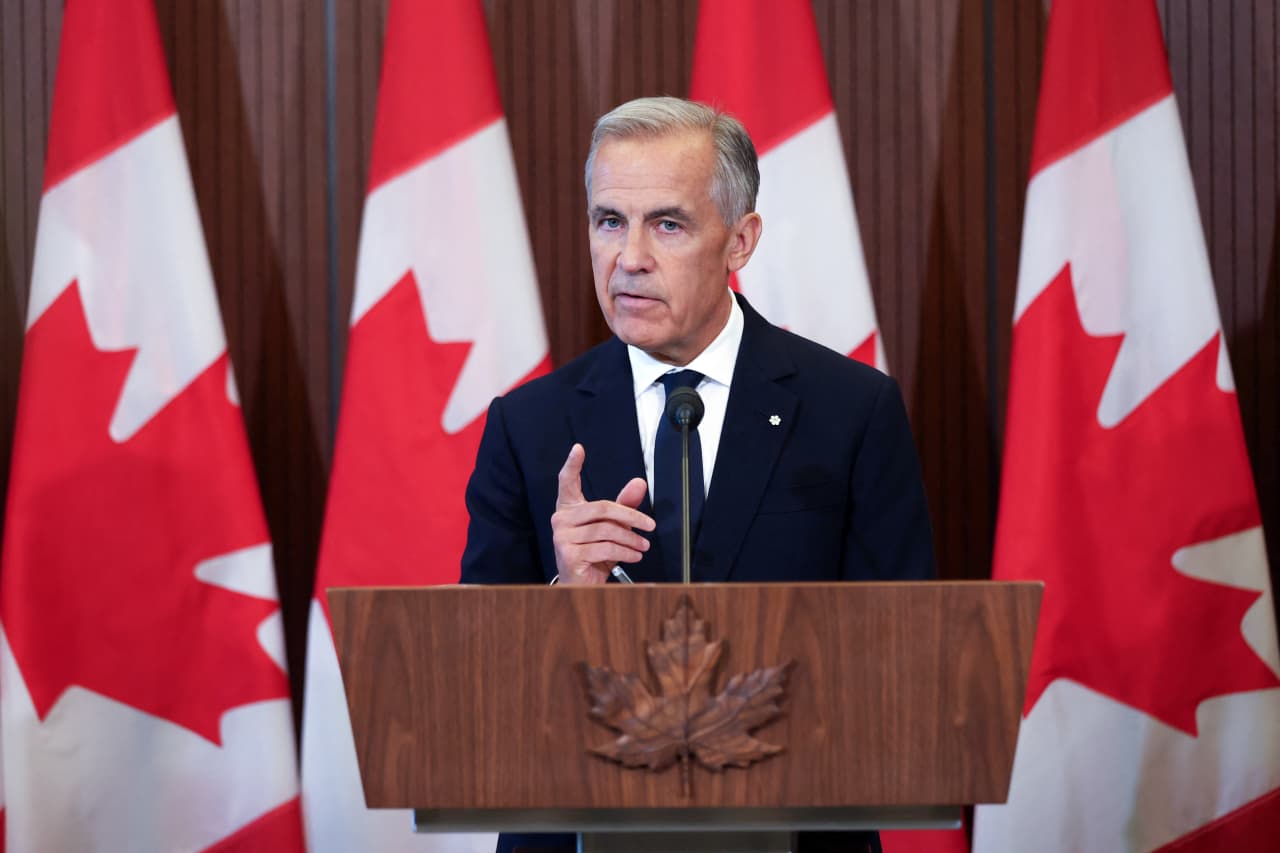
Canada Prime Minister Mark Carney on Saturday announced his country would impose “dollar-for-dollar” tariffs on U.S. goods — a retaliatory measure after trade talks between the two nations broke down late Friday, leading the U.S. to impose 50% tariffs on roughly $20 billion in Canadian goods.
Compare 8 other versions
CNBCTrade talks between the U.S. and Canada fell apart on Friday, triggering a new set of 50% Trump administration tariffs.
Washington Times BusinessThe United States imposed 50% tariffs on $20 billion worth of Canadian products early Saturday, and Canada immediately said it would retaliate, after last-ditch negotiations failed to resolve the latest strain in already tense relations between the historic allies.
FortuneThe United States imposed 50% tariffs on $20 billion worth of Canadian products early Saturday, and Canada immediately said it would retaliate after last-ditch negotiations failed to resolve the latest strain in relations between the historic allies.
ZeroHedgeUS-Canada trade negotiations collapsed at the 11th hour, just before the midnight deadline, triggering 50% tariffs on about $20 billion worth of Canadian goods (under a never-before- used Section 338 provision of the Tariff Act of 1930) and prompting globalist-aligned, China-sympathizing Prime Minister Mark Carney to promise an equivalent response.
BloombergCanada Pushes Back as US Trade Talks Collapse Bloomberg News Executive Editor for Canada Derek Decloet joins David Gura and Christina Ruffini on Bloomberg This Weekend and explains that Canadians are frustrated but not necessarily surprised after last-minute US-Canada negotiations collapsed, triggering 50% US tariffs on about $20 billion of Canadian goods and a dollar-for-dollar retaliation pledge from Ottawa. (Source: Bloomberg)
Financial TimesMark Carney says Canada is now ‘at war’ with US over trade Prime Minister says Donald Trump miscalculated by escalating his tariffs attack on the country
Epoch Times BusinessThe retaliatory tariffs were announced less than 24 hours after the United States imposed 50 percent tariffs on certain goods made in Canada, following the failure to reach a trade deal.
BBC BusinessPublished One of Canada's provincial leaders has criticised a prospective trade deal with the US and pushed his country to hold out for favourable terms, showing Prime Minister Mark Carney faces a tough battle in getting buy-in on the agreement as the hours tick down to a US-set deadline
-
“Tonight, Canada declined to finalize the trade deal under the terms agreed earlier this week. Despite the U.S. offer to Canada to receive the best treatment of any major exporter to our market, new demands and walk-backs of other commitments by Canada have upended the careful balance reached in the past days,” U.S. Trade Representative Jamieson Greer said in a statement read to reporters on a press call shortly before midnight.
Compare 5 other versions
FortuneCanada had sought concessions on tariffs on steel, aluminum, autos and lumber. “Tonight, Canada declined to finalize the trade deal under the terms agreed earlier this week. Despite the U.S. offer to Canada to receive the best treatment of any major exporter to our market, new demands and walk-backs of other commitments by Canada have upended the careful balance reached in the past days,” U.S. Trade Representative Jamieson Greer said in a statement read to reporters shortly before midnight.
CNBCU.S. Trade Representative Jamieson Greer told reporters in a White House briefing on Friday night that "Canada declined to finalize the trade deal under the terms agreed earlier this week."
ZeroHedge"Tonight, Canada declined to finalize the trade deal under the terms agreed earlier this week," the United States Trade Representative wrote on X early Saturday morning.
Epoch Times Business“Tonight, Canada declined to finalize the trade deal under the terms agreed earlier this week,” Greer said in a statement.
BBC BusinessDetails leaked to several media outlets suggest the US will agree to reduce tariffs on Canadian steel and aluminium from 50% to 25%, and tariffs on Canadian automobiles from 25% to 15%.
-
President Donald Trump’s import taxes will hit about 5% of what Canada ships to the United States every year, including products ranging from hockey sticks to tongue depressors.
Compare 1 other version
Washington Times BusinessPresident Trump’s import taxes will hit about 5% of what Canada ships to the United States every year, including products ranging from hockey sticks to tongue depressors.
-
Ontario Premier Doug Ford, who leads Canada’s most populous province, praised Carney for rejecting the deal, saying it would have hurt Ontario’s auto, steel and manufacturing sectors. Ford urged Canada to use “every tool in our toolbox” to fight the U.S. tariffs.
-
So Trump has looked for other legal authority to justify tariffs. To punish Canada, he reached back to the Great Depression, invoking Section 338 of the Tariff Act of 1930 to threaten 50% tariffs on products that account for about 5% of Canadian exports to the United States.
Compare 2 other versions
CNBCThe Trump administration signed three proclamations to impose the additional 50% tariffs on a range of Canadian goods in July, a response it said was due to trade discrimination against multiple U.S. products and industries such as motor vehicles, alcohol and dairy. The tariffs fell under Section 338 of the Tariff Act of 1930, which gives the president the power to impose tariffs of up to 50% on the goods of countries found to be discriminating against the U.S., and which had not been used since 1949.
Washington Times BusinessSo Trump has looked for other legal authority to justify tariffs. To hit Canada, he reached back to the Great Depression, invoking Section 338 of the Tariff Act of 1930 to threaten 50% tariffs on products that account for about 5% of Canadian exports to the United States.
-
Nearly a century ago, with the U.S. and world economies in collapse, Congress passed the 1930 tariff law, imposing taxes on imports from around the world. Known as the Smoot-Hawley tariffs after their congressional sponsors, they are notorious among economists and historians for limiting world commerce and making the Great Depression worse.
Compare 1 other version
FortuneNearly a century ago, with the U.S. and world economies in collapse, Congress passed the 1930 tariff law, imposing taxes on imports from around the world. Known as the Smoot-Hawley tariffs after their congressional sponsors, they are notorious among economists and historians for limiting world commerce and making the Great Depression worse.
-
“Canada likely wanted further sector-specific relief than the U.S. was willing to offer, or Canada’s concessions did not go far enough,’’ said Ryan Majerus, a partner at King & Spalding and a former U.S. trade official. “Either way, I think both sides will be under immense pressure in the coming days to still find an off-ramp. But if Canada has agreed to also impose tariffs, the off-ramp may be even harder to find.”
Compare 1 other version
Fortune“Canada likely wanted further sector-specific relief than the U.S. was willing to offer, or Canada’s concessions did not go far enough,” said Ryan Majerus, a partner at King & Spalding and a former U.S. trade official. “Either way, I think both sides will be under immense pressure in the coming days to still find an off-ramp. But if Canada has agreed to also impose tariffs, the off-ramp may be even harder to find.”
-
Candace Laing, president and CEO of the Canadian Chamber of Commerce, called the tariffs “a body blow to North American competitiveness” and warned they would raise costs for Americans while threatening Canadian customers, investment and small businesses.
Compare 1 other version
Washington Times BusinessCandace Laing, president and CEO of the Canadian Chamber of Commerce, called the tariffs “a body blow to North American competitiveness,” warning they would raise costs for Americans while threatening Canadian customers, investment and small businesses.
-
“Canada told the Americans in advance that if these tariffs landed, it would stop negotiating and retaliate,’’ said Barry Appleton, senior fellow at the Center for International Law at New York Law School. ”The American trade representative said publicly he would not tolerate retaliation. Both sides have now committed themselves in public, which is how escalation stops being a choice.’’ __ Associated Press writer Michelle L. Price contributed.
Compare 1 other version
Fortune“Canada told the Americans in advance that if these tariffs landed, it would stop negotiating and retaliate,” said Barry Appleton, senior fellow at the Center for International Law at New York Law School. ”The American trade representative said publicly he would not tolerate retaliation. Both sides have now committed themselves in public, which is how escalation stops being a choice.”
11 details only one outlet reported
Independent claims that didn't surface elsewhere in our corpus. Treat as supplementary — not corroborated across outlets.
-
01 Bloomberg Canada Digs In as US Trade Fight Escalates Joining Bloomberg This Weekend, Former Canadian Finance Minister Chrystia Freeland says Canada was right to walk away from a trade deal she argues would have harmed both countries, urging Ottawa not to back down and saying past retaliation against US tariffs proved effective. Freeland warns hosts David Gura and Christina Ruffini that Trump’s approach risks turning allies into “vassals” as Canada prepares dollar-for-dollar counter-tariffs after the US imposed new 50% duties. (This conversation was edited to omit an incorrect statement about the titles of Canadian government officials.) (Source: Bloomberg)
-
02 ZeroHedge The U.S. offer was also forward-looking and included a historic economic and national security partnership to cooperate on export controls, combat transshipment, enhance digital trade, and align certain external tariffs. The offer would have led to supply-chain coordination on aerospace, complementary actions to address unfair trade practices, critical-minerals cooperation, increased enforcement against imports produced with forced labor, and the announcement of formal U.S.-Mexico-Canada Agreement (USMCA) negotiations.
-
03 Fortune No further talks were planned. Whatever the eventual outcome, a loss of trust seems one of the earliest casualties.
-
04 Washington Times Business A typically cooperative alliance goes sour The political impact will likely be even bigger than the economic fallout. The countries sold each other $880 billion worth of goods and services last year.
-
05 CNBC Negotiators for both sides had been working on a deal all week, at times signaling that an agreement was near. President Donald Trump had postponed the original deadline of Wednesday just hours ahead of it being imposed, saying that there was a soon-to-be finalized deal. Dominic LeBlanc, Canada's trade minister for the U.S., told reporters on Thursday that a deal was "very close."
-
06 MarketWatch Carney said the the tariffs would take effect next month on the Tuesday after Labor Day, and would focus on sectors including steel, dairy, paper, electronics, appliances and agricultural equipment. About the Author Rey Mashayekhi is a West Coast news editor for MarketWatch.
-
07 Common Dreams No Bending the Knee Here Like every authoritarian before him, Trump is working to co-opt news sources and control what the public sees and hears. Too many corporate outlets are bending the knee—but not Common Dreams. We will never be intimidated, and we will never compromise the core values that define our community: social justice, universal human rights, equality, and peace. Because we are funded by ordinary people like you, our editorial freedom is guaranteed.
-
08 Financial Times Trump claims deal to cut beef import tariffs to help curb high prices Cattle futures fall after president says unnamed foreign suppliers will provide 25% discount for three months
-
09 BBC Business Negotiators have until Friday night to finalise the deal or risk a fresh wave of additional US tariffs on a wide range of Canadian goods.
-
10 Epoch Times Business “Let me be clear: We take this step reluctantly, reluctantly because we recognize that some of these measures will raise costs and reduce choice for Canadians,” Carney said during a press conference on Aug. 22. [OtterAI]
-
11 NPR Economy Audio will be available later today. NPR's Scott Simon talks to Peter Armstrong, senior business correspondent at the Canadian Broadcasting Corporation, about the collapse in US-Canada trade talks.
Fact Corroboration
Which sources independently confirm the same facts. Hover a claim to see its sources, or a source to see what it corroborates.
Coverage by Perspective
Source Similarity
Connections show how similarly each outlet covered this story. Thicker lines = more similar framing.
Sources (11)
- bbc-biz
- ft
- cnbc
- marketwatch
- epochtimes-biz
- zerohedge
- commondreams
- npr-economy
- bloomberg
- fortune
- washtimes-biz