NASA Captures New Images of Lunar Impact Crater After SpaceX Rocket Crashes
-
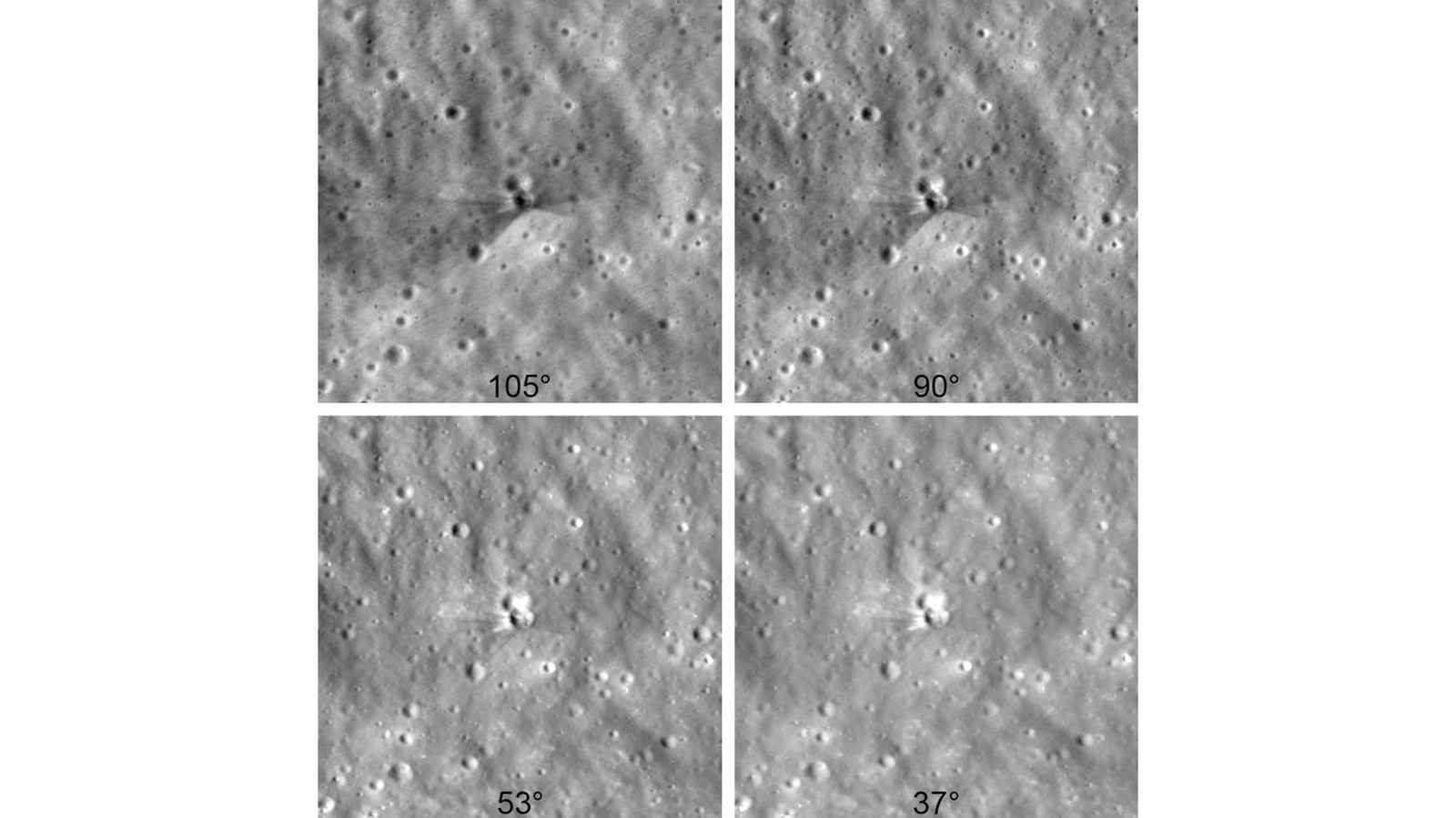
They were taken by the Lunar Reconnaissance Orbiter. In the early hours of August 5, the upper stage of a SpaceX Falcon 9 rocket crashed into the lunar surface. Now, NASA has released a series of images captured by the Lunar Reconnaissance Orbiter (LRO) from August 11 to 12, showing a new crater on the moon caused by the wandering rocket.
Compare 1 other version
GizmodoThe Falcon 9 rocket crashed into the lunar surface after being stranded in a highly elliptical orbit, and NASA’s Lunar Reconnaissance Orbiter (LRO) captured a series of images of a new crater that formed from the impact.
-
Fresh scar To capture the new images, NASA engineers tilted the spacecraft so its cameras would point toward the crater each time LRO passed above the Moon at a distance of around 60 miles (96 kilometers). Using a variety of viewing angles, scientists could see the crater under several lighting conditions to show its unique features.
Compare 1 other version
EngadgetTo capture the images, NASA engineers had to tilt the spacecraft sideways so its cameras would point downward as it passed 60 miles above the crater. Specifically, they used LRO's Narrow-Angle Camera, which can see features on the lunar surface as small as three feet wide.
-
LRO circles the Moon from pole to pole every two hours as Earth’s natural satellite rotates underneath it. The spacecraft must wait until a specific spot turns into view to capture a photograph, which took six days in this case. If LRO’s camera was even 10 seconds off, the targeted area would have drifted off-center by 10 miles (16 kilometers).
Compare 1 other version
EngadgetIt wasn't an easy feat, as the spacecraft flew from pole to pole every two hours at a speed of 1 mile per second, while the Moon rotated on its axis underneath. NASA had to wait for the LRO and the crash site to align, and that took six days. The agency did, however, release before-and-after photos, which you can see on the official site.
-
Meanwhile, the photos above show the crash site from different angles. The darker streak radiating out of the crater is made of older materials from near the surface: Dust and rocks whose colors and components have already been altered by years of exposure to solar winds and cosmic rays. The lighter materials near the rim came from deeper underground.
Compare 1 other version
GizmodoLRO used its Narrow-Angle Camera to capture the crater in detail, revealing dark and bright rays emanating from the crash site. The brighter rays and splotch above the crater is fresher material that was excavated from deeper below the surface.
-
The rocket was roughly 39 feet (12 meters) long, 13 feet (4 meters) wide, and weighed about 8,800 pounds (4,000 kilograms). Astronomers first calculated the rocket’s trajectory using publicly available data, after which NASA used its Center for Near Earth Object Studies to refine the trajectory and identify the location of the impact.
Compare 1 other version
EngadgetIndependent astronomer Bill Grey first drew attention to a rocket on a collision course with the Moon in April. He used orbit-computing software to figure out where and when the rocket was crashing. Grey and his colleagues also used a physics simulator to analyze the data, predicting that the upper stage wouldn't make much of an impact. The rocket was 39 feet long and 13 feet wide, weighing around 4,000 kilograms. It slammed into the Moon at 5,400 mph and, based on NASA's calculations, created a crater 60 feet wide and 12 feet deep.
1 detail only one outlet reported
Independent claims that didn't surface elsewhere in our corpus. Treat as supplementary — not corroborated across outlets.
-
01 Gizmodo The crater appears to be 60 feet wide (18 meters) and less than 10 feet deep (3 meters), according to NASA.
Fact Corroboration
Which sources independently confirm the same facts. Hover a claim to see its sources, or a source to see what it corroborates.
Coverage by Perspective
Source Similarity
Connections show how similarly each outlet covered this story. Thicker lines = more similar framing.
Sources (2)
- gizmodo
- engadget