North Korea Rejects Trump Outreach, Shifts Foreign Policy
-
North Korea shrugs off Trump’s outreach Kim Yo Jong, the influential sister of North Korean leader Kim Jong Un, brushed aside Trump’s overture on Wednesday, saying that reducing the duration and size of the drills won’t change their “provocative, aggressive nature.”
Compare 5 other versions
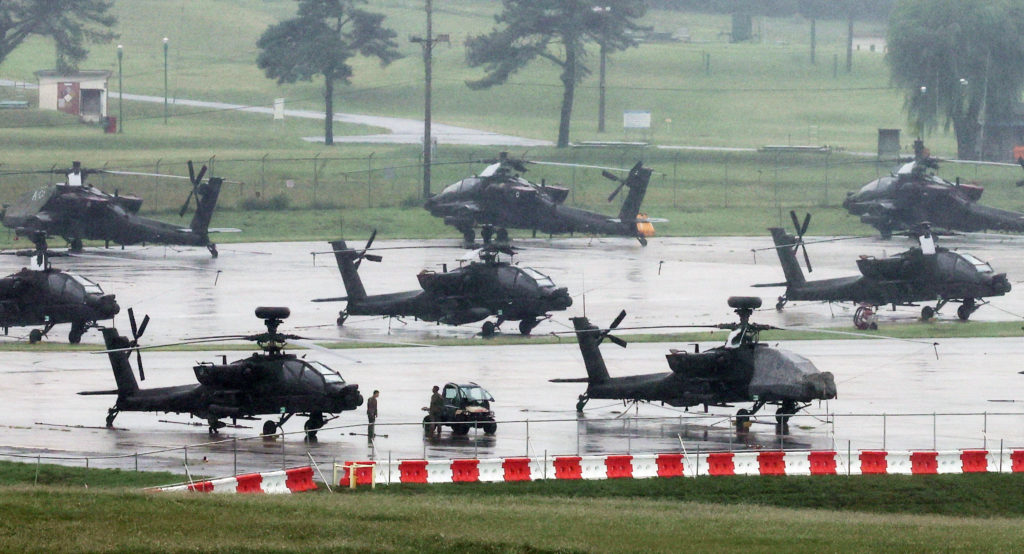
PBS NewsHourU.S.-South Korea military drill wraps up early, a day after North Korea's missile barrage President Donald Trump had earlier abruptly ordered the Pentagon to "substantially reduce" the Ulchi Freedom Shield exercise just before it began Monday. Trump cited what he described as a good relationship with North Korean leader Kim Jong Un and South Korea's refusal to support him over the war in Iran.
Associated PressKim Yo Jong, the influential sister of North Korean leader Kim Jong Un, brushed aside Trump’s overture on Wednesday, saying “the provocative, aggressive nature of the drills” won’t change only with the reduction of their duration and size.
NPR NewsSEOUL - North Korea rebuffed President Trump's apparent bid to reengage with Pyongyang diplomatically this week, issuing rhetorical salvos aimed at Trump's last-minute orders to shorten U.S.- South Korea joint military exercises.
BBC NewsAlthough it has traditionally been happy to scale down or suspend the exercises in order to lure North Korea to peace talks, Trump's unilateral and sudden decision to pull his troops early has shaken South Korean confidence in the US as an ally, according to Jo Bee-yun, a Senior Research Fellow at the Atlantic Council.
BreitbartKim Yo-jong, who the dictator typically uses to threaten and insult perceived enemies, published two screeds on Wednesday and Thursday: one claiming that she did not care about the limited military exercises, and one commenting extensively on the limited military exercises she purportedly did not care about. The first confirmed that Kim Jong-un is still fond of Trump, but Kim Yo-jong wrote that she could neither confirm nor deny comments from Trump that day that he had been personally communicating with her brother.
-
That led to a landmark shift in North Korea's foreign policy, which has strengthened Kim's position. In 2023, North Korea formally abandoned the goal of reunifying with South Korea. Kim also signed a mutual defense pact with Russia, and revived ties with China, all but ruling out any role for South Korea as mediator.
Compare 1 other version
BBC NewsThe two Koreas are technically still at war since they did not sign a peace treaty after the Korean War. Reuniting with the South had always been a key, if increasingly unrealistic, part of the North's ideology until Kim abandoned it in 2024.
-
And while South Korea has long been keen on Trump reaching out to Kim as a means of maintaining diplomacy, it would not have wanted it to come with demands for cash and military assistance in Iran.
Compare 1 other version
NPR NewsOfficially, South Korea said it hoped Trump's outreach would lead to renewed diplomatic engagement with North Korea.
-
South Korean Foreign Minister Cho Hyun told lawmakers on Wednesday he'd do his best "to make sure the South Korea-U.S. alliance does not weaken" as the U.S. pursues dialogue with Pyongyang. Cho admitted that Seoul was caught off guard by Trump's orders.
Compare 1 other version
BBC NewsSeoul's Foreign Minister Cho Hyun tried to paint the decision as one of mutual agreement, but admitted officials did not know of Trump's intent to scale down the exercise in advance.
-
An unnamed official at the South Korean Unification Ministry told reporters on Friday that the government of leftist President Lee Jae-myung supports “direct” talks between President Donald Trump and North Korean communist dictator Kim Jong-un to facilitate an end to the 76-year-old Korean War.
Compare 1 other version
NPR NewsThe administrations of President Trump and South Korean President Lee Jae Myung "actually share several broad objectives," notes Yu Jihoon, a research fellow at the Korea Institute for Defense Analyses, a government think tank. They include restarting diplomacy with North Korea and increasing South Korea's responsibility for defending itself.
-
Trump seeks to rekindle bromance with Kim Jong Un President Trump is pushing to rekindle his first-term bromance with North Korea’s Kim Jong Un, expressing his desire for another rendezvous after reducing joint military exercises with South Korea in an effort to appease the dictator.  The president met with Kim three times during his first term, but ultimately, denuclearization talks stalled and the relationship…
Compare 1 other version
BBC NewsSince Trump's first term, Seoul has seen his seemingly capricious approach to diplomacy as both a risk and an opportunity. With a mix of flattery and blind optimism, Seoul succeeded in setting up a first-ever meeting between a sitting US president and Kim Jong Un in 2018.
-
Meanwhile Trump has maintained that he enjoys a "great relationship" with Kim, telling reporters on Wednesday: "He likes me".
Compare 1 other version
Breitbart“I had already clarified several times that our head of state has good memories and feelings about Trump personally,” Kim continued. “The relationship between those two leaders is still excellent. It is well known to the world and not a matter to be surprised, I think.”
-
With its supply of ammunition and troops to Russia, North Korea is likely receiving economic and military assistance in return, and its expanding ties with Russia provides it with leverage to ask for greater support from China, its biggest trading partner.
Compare 1 other version
Washington TimesMore nuclear weapons, Russia ties give North Korea greater leverage With its supply of ammunition and troops to Russia, North Korea is likely receiving economic and military assistance in return, and its expanding ties with Russia provides it with leverage to ask for greater support from China, its biggest trading partner.
8 details only one outlet reported
Independent claims that didn't surface elsewhere in our corpus. Treat as supplementary — not corroborated across outlets.
-
01 NPR News But she acknowledged that while U.S. policies towards North Korea remain hostile, "the relationship between the two leaders is still excellent."
-
02 The Hill What Trump’s cold shoulder toward South Korea means to our allies Trump's coupling of his desire to meet the North Korean dictator with the cutback in joint exercises with South Korea sends the wrong message.
-
03 BBC News This revelation by Trump, who called the exercise "inappropriate and hostile" towards North Korea and costly to the US, caught his allies by surprise.
-
04 Associated Press “After this strategic play has run its course, Kim may seek further economic and reputational benefits from Washington,” said Leif-Eric Easley, a professor at Ewha University in Seoul. “But that will probably be after the U.S. midterm elections when Trump is expected to be in a weaker domestic political position and in search of headline-grabbing foreign policies.”
-
05 Washington Times “After this strategic play has run its course, Kim may seek further economic and reputational benefits from Washington,” said Leif-Eric Easley, a professor at Ewha University in Seoul. “But that will probably be after the U.S. midterm elections when Trump is expected to be in a weaker domestic political position and in search of headline-grabbing foreign policies.”
-
06 RealClearPolitics First, the Trump administration issued an executive order that targets the practice of “birth tourism” and surrogate births, mostly by Chinese nationals, which were exposed in Peter Schweizer’s bestselling book, The Invisible Coup. After the Supreme Court ruled against the administration’s previous order curbing birthright citizenship in Trump v. Barbara, this new order seeks to focus immigration and birthright citizenship rules so they might withstand a future court challenge.
-
07 New York Times The China Shock 2.0 China is winning the industries of the future. What should the U.S. do about it?
-
08 Breitbart The official made the remark in the context of President Trump announcing on Sunday that he had ordered a significant reduction in the time and scale of the Ulchi Freedom Shield exercises, which Seoul and Washington hold annually to prepare for any potential resumption of the Korean War. While the war began with the communist north invading the south in 1950, active hostilities ended in 1953 with the signing of an armistice agreement between the warring parties: South Korea and America on one side and North Korea and China on the other. The armistice agreement did not end the war, as it does not constitute a peace treaty and did not result in either side’s surrender.
Fact Corroboration
Which sources independently confirm the same facts. Hover a claim to see its sources, or a source to see what it corroborates.
Coverage by Perspective
Source Similarity
Connections show how similarly each outlet covered this story. Thicker lines = more similar framing.
Sources (9)
- pbs
- nyt
- ap
- breitbart
- npr
- thehill
- rcp
- bbc
- washtimes