Canada Breaks Off from U.S. Tariff Negotiations Amid Escalating Tensions
-
Tensions escalated late Friday when Canada walked away from negotiations after Carney concluded the United States was demanding too much in exchange for tariff relief. The U.S. imposed 50% duties Saturday on about $20 billion worth of Canadian goods, and Carney announced dollar-for-dollar retaliation beginning Sept. 8.
Compare 8 other versions
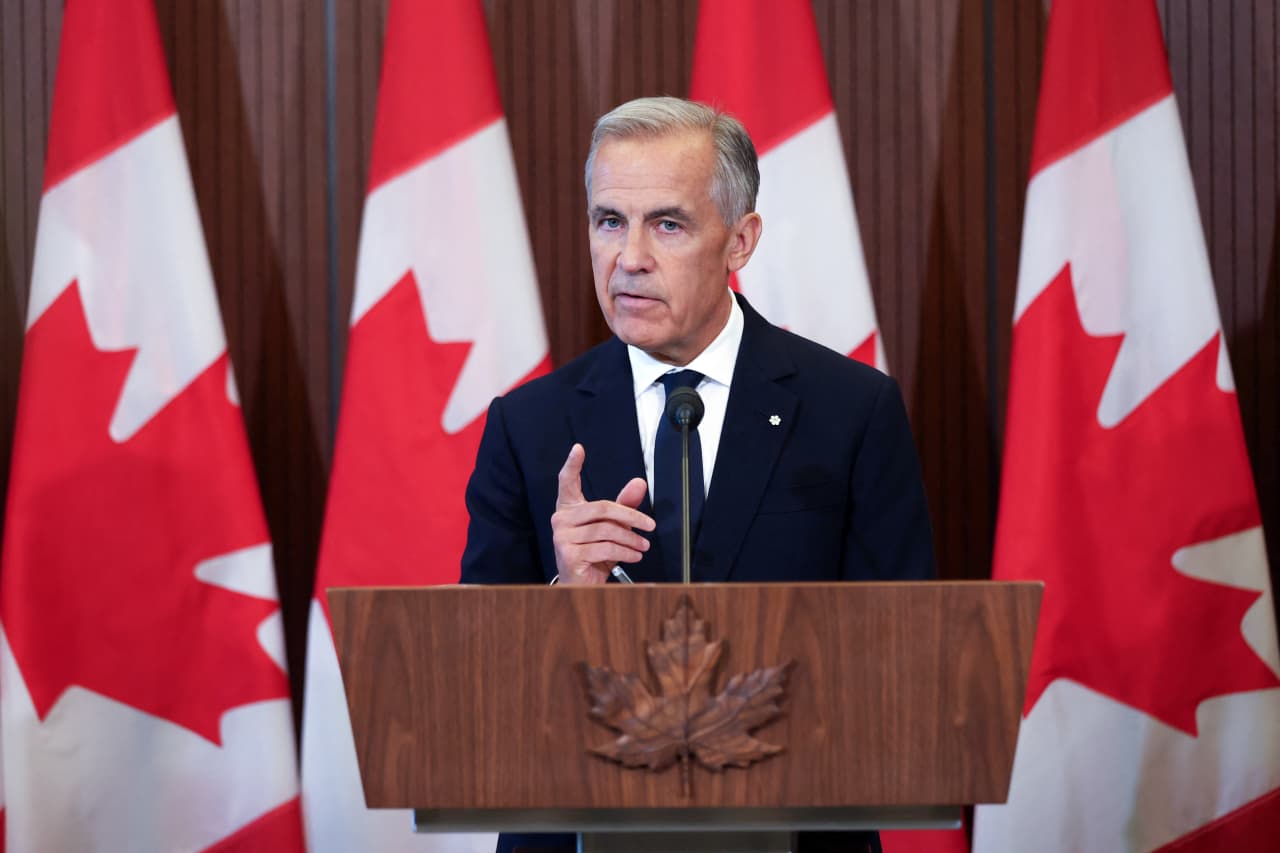
MarketWatchCanada Prime Minister Mark Carney on Saturday announced his country would impose “dollar-for-dollar” tariffs on U.S. goods — a retaliatory measure after trade talks between the two nations broke down late Friday, leading the U.S. to impose 50% tariffs on roughly $20 billion in Canadian goods.
CNBCCanada's Prime Minister Mark Carney said he had suspended trade negotiations and Canada would retaliate dollar for dollar on the new tariffs.
Epoch Times BusinessCarney said Canada reluctantly decided to impose the measures after rejecting what he called a “bad deal.” Both countries blamed the other for the breakdown. Carney accused the United States of seeking restrictions on Canada’s ability to negotiate trade agreements with other countries.
Washington Times Business“Tonight, Canada declined to finalize the trade deal under the terms agreed earlier this week. Despite the U.S. offer to Canada to receive the best treatment of any major exporter to our market, new demands and walk-backs of other commitments by Canada have upended the careful balance reached in the past days,” U.S. Trade Representative Jamieson Greer said in a statement read to reporters on a press call shortly before midnight.
ZeroHedgeUS-Canada trade negotiations collapsed at the 11th hour, just before the midnight deadline, triggering 50% tariffs on about $20 billion worth of Canadian goods (under a never-before- used Section 338 provision of the Tariff Act of 1930) and prompting globalist-aligned, China-sympathizing Prime Minister Mark Carney to promise an equivalent response.
BloombergCanada Pushes Back as US Trade Talks Collapse Bloomberg News Executive Editor for Canada Derek Decloet joins David Gura and Christina Ruffini on Bloomberg This Weekend and explains that Canadians are frustrated but not necessarily surprised after last-minute US-Canada negotiations collapsed, triggering 50% US tariffs on about $20 billion of Canadian goods and a dollar-for-dollar retaliation pledge from Ottawa. (Source: Bloomberg)
Financial TimesMark Carney says Canada is now ‘at war’ with US over trade Prime Minister says Donald Trump miscalculated by escalating his tariffs attack on the country
BBC BusinessPublished One of Canada's provincial leaders has criticised a prospective trade deal with the US and pushed his country to hold out for favourable terms, showing Prime Minister Mark Carney faces a tough battle in getting buy-in on the agreement as the hours tick down to a US-set deadline
-
The Trump administration signed three proclamations to impose the additional 50% tariffs on a range of Canadian goods in July, a response it said was due to trade discrimination against multiple U.S. products and industries such as motor vehicles, alcohol and dairy. The tariffs fell under Section 338 of the Tariff Act of 1930, which gives the president the power to impose tariffs of up to 50% on the goods of countries found to be discriminating against the U.S., and which had not been used since 1949.
Compare 4 other versions
Epoch Times BusinessThe Trump administration has said the tariffs are a response to several Canadian trade policies, including its dairy supply-management system, provincial restrictions on sales of U.S. alcohol, and Canadian retaliatory tariffs on automobiles.
Washington Times BusinessSo Trump has looked for other legal authority to justify tariffs. To hit Canada, he reached back to the Great Depression, invoking Section 338 of the Tariff Act of 1930 to threaten 50% tariffs on products that account for about 5% of Canadian exports to the United States.
FortuneSo Trump has looked for other legal authority to justify tariffs. After the Supreme Court struck down much of Trump’s earlier tariff program in February, the administration turned to other legal authorities. For Canada, Trump invoked Section 338 of the Tariff Act of 1930, a rarely used Depression-era provision allowing tariffs of up to 50% against countries deemed to discriminate against U.S. businesses.
ZeroHedgeFor decades, Canada has enjoyed the most favorable access to the U.S. market of any country. And from the beginning of President Trump's trade program, Canada has continued to enjoy the best treatment in the world, even after, like China, retaliating against the United States. This week, the United States agreed to provide even better treatment to Canada, offering significant tariff reductions on steel, aluminum, autos, and lumber.
-
The proposed deal would have reduced U.S. tariffs on Canadian steel, aluminum, automobiles, and lumber. It also included cooperation on aerospace supply chains, critical minerals, forced-labor enforcement, and the formal launch of negotiations over the U.S.–Mexico–Canada Agreement.
Compare 2 other versions
ZeroHedgeThe proposed US-Canada trade deal would have reduced US tariffs on Canadian steel and aluminum to 25%, lowered automotive duties to 15%, and eliminated a 10% levy on lumber. It also included cooperation on export controls and digital trade, as well as formal negotiations to renew the US-Mexico-Canada Agreement.
BBC BusinessDetails leaked to several media outlets suggest the US will agree to reduce tariffs on Canadian steel and aluminium from 50% to 25%, and tariffs on Canadian automobiles from 25% to 15%.
-
Manitoba Premier Wab Kinew said Canadians should be prepared for a prolonged confrontation and that Trump could emerge weaker after the U.S. midterm elections in November.
Compare 1 other version
BBC BusinessStill, Manitoba Premier Wab Kinew said Canada "should fight" and not rush to make concessions.
-
The new U.S. tariffs affect about 5 percent of Canadian exports to the United States and target products including dairy, alcohol, and other consumer goods.
Compare 3 other versions
FortunePresident Donald Trump’s import taxes will hit about 5% of what Canada ships to the United States every year, ranging from hockey sticks to tongue depressors. Prime Minister Carney said Ottawa would respond with targeted tariff protection for industries exposed to the new U.S. duties, including some steel products. He also mentioned the dairy, appliance, agricultural equipment, pulp and paper and electronics sectors.
CNBCWhile the new measures affect a relatively small share of Canadian exports, they add to existing U.S. tariffs on steel, lumber and autos. The new tariffs could thwart Canada's fragile economic recovery and impact how the two neighbors engage in the coming months on broader negotiations for a free-trade pact.
Washington Times BusinessPresident Trump’s import taxes will hit about 5% of what Canada ships to the United States every year, including products ranging from hockey sticks to tongue depressors.
-
The tariffs had been scheduled to take effect Aug. 19, but Trump delayed them for three days while negotiations continued.
Compare 2 other versions
Washington Times BusinessThe tariffs were initially supposed to kick in at 12:01 a.m. Wednesday. But Trump extended the deadline for three days to allow talks to continue, but the two countries still could not reach an agreement in time.
FortuneThe tariffs were initially supposed to kick in at 12:01 a.m. Wednesday. Trump extended the deadline for three days to allow talks to continue, but the countries could not reach an agreement in time.
-
The provision is part of the Smoot-Hawley tariff law, widely blamed by economists and historians for worsening the Great Depression by restricting global trade. Section 338 has never previously been used to impose tariffs.
Compare 1 other version
Washington Times BusinessNearly a century ago, with the U.S. and world economies in collapse, Congress passed the 1930 tariff law, imposing taxes on imports from around the world. Known as the Smoot-Hawley tariffs after their congressional sponsors, they are notorious among economists and historians for limiting world commerce and making the Great Depression worse.
11 details only one outlet reported
Independent claims that didn't surface elsewhere in our corpus. Treat as supplementary — not corroborated across outlets.
-
01 ZeroHedge The U.S. offer was also forward-looking and included a historic economic and national security partnership to cooperate on export controls, combat transshipment, enhance digital trade, and align certain external tariffs. The offer would have led to supply-chain coordination on aerospace, complementary actions to address unfair trade practices, critical-minerals cooperation, increased enforcement against imports produced with forced labor, and the announcement of formal U.S.-Mexico-Canada Agreement (USMCA) negotiations.
-
02 Fortune “We’re going to hit back,” Carney said. Carney is doing what many other American allies have so far avoided: risking economic pain rather than yielding to tariff pressure.
-
03 Washington Times Business A typically cooperative alliance goes sour The political impact will likely be even bigger than the economic fallout. The countries sold each other $880 billion worth of goods and services last year.
-
04 Bloomberg Canada Digs In as US Trade Fight Escalates Joining Bloomberg This Weekend, Former Canadian Finance Minister Chrystia Freeland says Canada was right to walk away from a trade deal she argues would have harmed both countries, urging Ottawa not to back down and saying past retaliation against US tariffs proved effective. Freeland warns hosts David Gura and Christina Ruffini that Trump’s approach risks turning allies into “vassals” as Canada prepares dollar-for-dollar counter-tariffs after the US imposed new 50% duties. (This conversation was edited to omit an incorrect statement about the titles of Canadian government officials.) (Source: Bloomberg)
-
05 Epoch Times Business The prime minister added Canada was committed to working together to build one Canadian economy by removing internal trade barriers.
-
06 CNBC Negotiators for both sides had been working on a deal all week, at times signaling that an agreement was near. President Donald Trump had postponed the original deadline of Wednesday just hours ahead of it being imposed, saying that there was a soon-to-be finalized deal. Dominic LeBlanc, Canada's trade minister for the U.S., told reporters on Thursday that a deal was "very close."
-
07 MarketWatch Carney said the the tariffs would take effect next month on the Tuesday after Labor Day, and would focus on sectors including steel, dairy, paper, electronics, appliances and agricultural equipment. About the Author Rey Mashayekhi is a West Coast news editor for MarketWatch.
-
08 Common Dreams No Bending the Knee Here Like every authoritarian before him, Trump is working to co-opt news sources and control what the public sees and hears. Too many corporate outlets are bending the knee—but not Common Dreams. We will never be intimidated, and we will never compromise the core values that define our community: social justice, universal human rights, equality, and peace. Because we are funded by ordinary people like you, our editorial freedom is guaranteed.
-
09 Financial Times Trump claims deal to cut beef import tariffs to help curb high prices Cattle futures fall after president says unnamed foreign suppliers will provide 25% discount for three months
-
10 BBC Business Negotiators have until Friday night to finalise the deal or risk a fresh wave of additional US tariffs on a wide range of Canadian goods.
-
11 NPR Economy Audio will be available later today. NPR's Scott Simon talks to Peter Armstrong, senior business correspondent at the Canadian Broadcasting Corporation, about the collapse in US-Canada trade talks.
Fact Corroboration
Which sources independently confirm the same facts. Hover a claim to see its sources, or a source to see what it corroborates.
Coverage by Perspective
Source Similarity
Connections show how similarly each outlet covered this story. Thicker lines = more similar framing.
Sources (11)
- bbc-biz
- ft
- cnbc
- epochtimes-biz
- marketwatch
- zerohedge
- commondreams
- npr-economy
- bloomberg
- fortune
- washtimes-biz