Hungary's Pivotal Election: Orbán Faces Unprecedented Challenge Amid U.S. Support and Polling Deficit

Broke: Updated:
Hungary's Pivotal Election: Orbán Faces Unprecedented Challenge Amid U.S. Support and Polling Deficit
Photo: PBS NewsHour

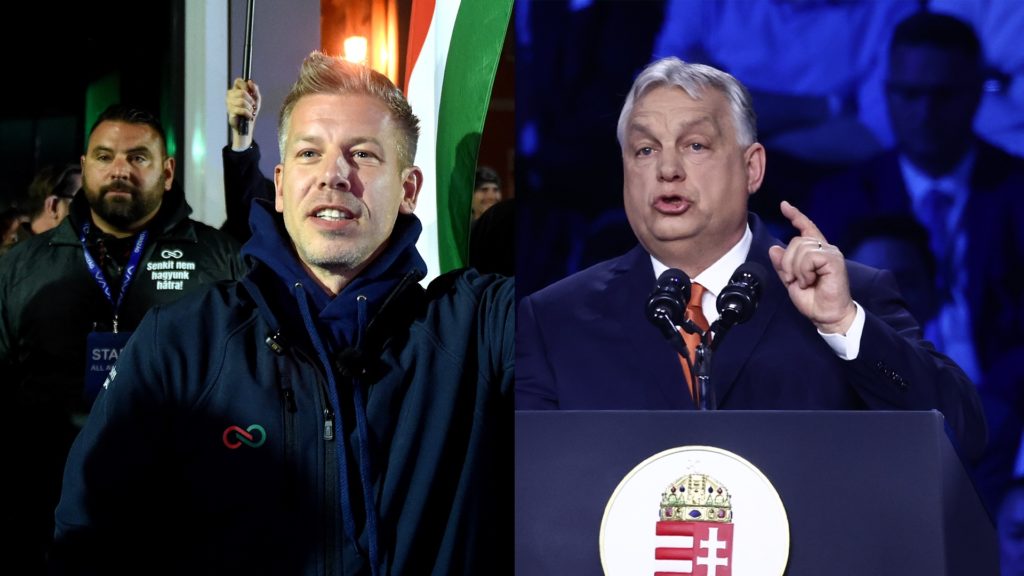
BUDAPEST, Hungary — Hungarian Prime Minister Viktor Orbán faces his most significant electoral challenge in 16 years as the country heads to the polls this Sunday. While long-time allies, including U.S. Vice President JD Vance and former President Donald Trump, have publicly campaigned for his re-election, recent polling indicates that Orbán's Fidesz party is trailing the center-right opposition Tisza party led by Péter Magyar.

The election has drawn intense international scrutiny as a potential bellwether for the global far-right movement. According to Reuters, opposition polls show Tisza retaining a lead over Fidesz, though the margin remains tight. The Associated Press notes that while Orbán retains a solid base in rural areas, urban centers and younger voters have increasingly turned toward the opposition, citing dissatisfaction with corruption and economic mismanagement.

The campaign has been marked by a high-profile intervention from the United States. Vice President JD Vance traveled to Budapest earlier this week, appearing alongside Orbán in a show of solidarity. During the visit, Vance criticized the European Union, claiming Brussels bureaucrats attempted to "destroy" Hungary's economy. Fact-checkers from The Guardian noted that these claims contradict data showing Hungary is a net recipient of EU funds.

Former President Trump also weighed in via Truth Social, urging Hungarians to "get out and vote for" Orbán, whom he described as a "truly strong and powerful Leader." The White House has signaled that the outcome of this election is critical to U.S.-European relations, with officials viewing Orbán as a key ally in the transatlantic alliance.

Despite this external support, domestic sentiment appears to be shifting. The New York Times reported on growing frustration in towns around Lake Balaton, where luxury real estate developments linked to Orbán's circle have displaced locals. The Guardian editorialized that a defeat for Orbán would be "celebrated in Brussels" and could restore democratic checks and balances that the Prime Minister has systematically dismantled over his decade-and-a-half in power.

The stakes extend beyond Hungary's borders. The PBS NewsHour highlighted that the election could alter Europe's political landscape, particularly regarding NATO and EU cohesion. If Orbán loses, it would mark the end of his "illiberal democracy" project and potentially reshape Hungary's place in Europe. Conversely, a victory would solidify his position as a dominant figure in European conservatism.

Investors are already positioning for potential outcomes, with Reuters reporting that markets are reacting to the possibility of a post-Orbán government. The AP noted that Péter Magyar, once a government insider, has successfully tapped into voter frustration to mount the most serious challenge to Orbán's grip on power.

As election day approaches, the contrast remains stark: a leader with significant institutional advantages and foreign backing facing an energized opposition movement fueled by domestic discontent. The results will be closely watched in Washington, Brussels, and Moscow, where the implications of a potential shift in Hungarian governance are profound.

Coverage Analysis

The coverage of the Hungarian election reveals a sharp divergence in how outlets frame the stakes, the nature of Viktor Orbán's leadership, and the implications of JD Vance's involvement. While center outlets focus on polling data and institutional mechanics, left-leaning sources frame the election as a democratic crisis with moral urgency. Right-leaning outlets, conversely, frame Vance's intervention as necessary geopolitical strategy and dismiss criticism of Orbán as Western elitism.

Democratic Erosion and Moral Imperative

Orbán's dismantling of democratic checks and balances

The moral stakes for the EU and global democracy

Specific grievances of displaced locals (Lake Balaton)

Fact-checking Vance's claims as misleading

Uses terms like 'illiberal democracy,' 'dismantled checks and balances,' and 'far right.'

The Guardian's editorial explicitly frames a loss as restoring democracy ('give his country its democracy back').

The Atlantic focuses on the existential question of whether Orbán would accept defeat.

Fact-checking is central; The Guardian explicitly contrasts Vance's claims with data on EU funds.

Minimal focus on the economic benefits of Orbán's policies to rural voters.

Downplays the strategic necessity of US-Hungary ties in favor of democratic norms.

Geopolitical Bellwether and Institutional Mechanics

Polling data (Tisza leading Fidesz)

The impact on NATO and EU cohesion

Péter Magyar's background as a former insider

Market reactions to potential regime change

Neutral, descriptive language ('pivotal test,' 'closely watched,' 'alter Europe's political landscape').

Focuses on the 'how' and 'what if' rather than the moral judgment of the actors.

Cites specific data points from Reuters and AP regarding rural vs. urban divides.

Avoids editorializing on the morality of Orbán's rule.

Does not take a stance on whether Vance's intervention was appropriate, simply reporting it as a fact.

Strategic Alliance and Western Survival

Vance's intervention as a show of strength and solidarity

Orbán as a 'strong' leader and key ally against the EU bureaucracy

The narrative that Western institutions (EU, WSJ) are 'baffled' or hostile to Orbán

The importance of the US-Hungary partnership in a multipolar world

The Daily Wire frames Vance's visit as 'shoring up allies' and contrasts the US with an 'enfeebled Britain.'

The Hill highlights Trump's praise for Orbán as a 'truly strong and powerful Leader.'

Language suggests the EU is an antagonist ('bureaucrats in Brussels') rather than a partner.

RealClearPolitics frames the US role as that of a 'World Superpower' protecting its interests.

Omits the specific details of corruption allegations or local displacement (Lake Balaton).

Ignores the fact-checking of Vance's economic claims.

Downplays the domestic opposition's legitimacy, framing it as a struggle against external interference.

Vance is an active campaigner for a 'far-right' leader, making claims that are factually incorrect regarding the EU economy. His presence is framed as an escalation of foreign interference.

Vance's visit is a significant diplomatic event that signals the White House's strategic priorities, with officials viewing the outcome as critical to transatlantic relations.

Vance is a pragmatic statesman protecting a vital ally against hostile EU bureaucrats. His intervention is framed as necessary to maintain US influence and support strong leadership.

Illegitimate due to the erosion of democratic norms; his defeat is a moral victory for democracy.

A long-standing leader facing his toughest challenge, with a specific demographic split (rural vs. urban) driving the race.

A 'strong' leader and key ally whose policies are misunderstood by Western elites; his support is based on genuine political strength.

A necessary partner for democracy, though potentially bureaucratic; a loss for Orbán would be 'celebrated in Brussels.'

A key stakeholder whose cohesion is at risk; a neutral entity in the geopolitical equation.

An antagonist ('bureaucrats') attempting to 'destroy' the Hungarian economy; a force of interference.

The divergence in coverage highlights a fundamental split in how the American media interprets the rise of right-wing populism. Left-leaning outlets view the Hungarian election through a lens of democratic backsliding, prioritizing institutional norms and fact-checking. Right-leaning outlets view it through a lens of realpolitik, prioritizing strategic alliances and framing the EU as an adversary. Center outlets serve as a bridge, focusing on the mechanics of power and the geopolitical consequences without moral judgment. This split suggests that readers consuming different outlets will not just see different facts, but fundamentally different stories about the nature of Orbán's power and the role of the United States in Europe.

Coverage by Perspective

Left
2
Lean-Left
3
Center
9
Lean-Right
2
Right
1

Source Similarity

Connections show how similarly each outlet covered this story. Thicker lines = more similar framing.

Sources (11)

  • npr
  • dailywire
  • rcp
  • democracynow
  • reuters
  • atlantic
  • guardian
  • pbs
  • ap
  • thehill
  • nyt

Original Articles (17)

Center Hungarian election could end Orbán's grip on power and alter Europe's political landscape — PBS NewsHour
Left Viktor Orbán Could Actually Lose — The Atlantic
Center Key facts about Sunday's election in Hungary and possible outcomes - Reuters — Reuters
Center Five things to know about Hungary's election — NPR News
Left Ahead of Hungary Election, JD Vance Campaigns With Orbán in Show of Support For Far Right in Europe — Democracy Now
Center What’s behind Péter Magyar’s ascent from a government insider to Orbán’s top challenger - AP News — Associated Press
Lean Left This Hungarian Town Explains Why Orban Could Lose on Sunday — New York Times
Center Hungarian opposition leads PM Orban's Fidesz, poll shows - Reuters — Reuters
Lean Right Trump urges Hungarians to ‘get out and vote for’ ally Orbán as election looms — The Hill
Lean Left The Guardian view on Hungary’s election: a bellwether contest for the global far right | Editorial — The Guardian US
Center Orbán’s rural base is still behind the Hungarian leader ahead of Sunday’s pivotal vote - AP News — Associated Press
Center Hungary's election could end Orban era and reshape its place in Europe - Reuters — Reuters
Lean Left JD Vance’s claims about Orbán, the EU and Hungary fact-checked — The Guardian US
Lean Right This Is What a World Superpower Looks Like — RealClearPolitics
Center Hungary's opposition Tisza retains lead over PM Orban's Fidesz, poll shows - Reuters — Reuters
Right The WSJ Is Baffled By JD Vance’s U.S. Diplomacy In Hungary — The Daily Wire
Center Investors position for a post-Orban Hungary - Reuters — Reuters