U.S. Imposes Naval Blockade on Iran Over Strait of Hormuz, Economic Consequences Loom Amid
-
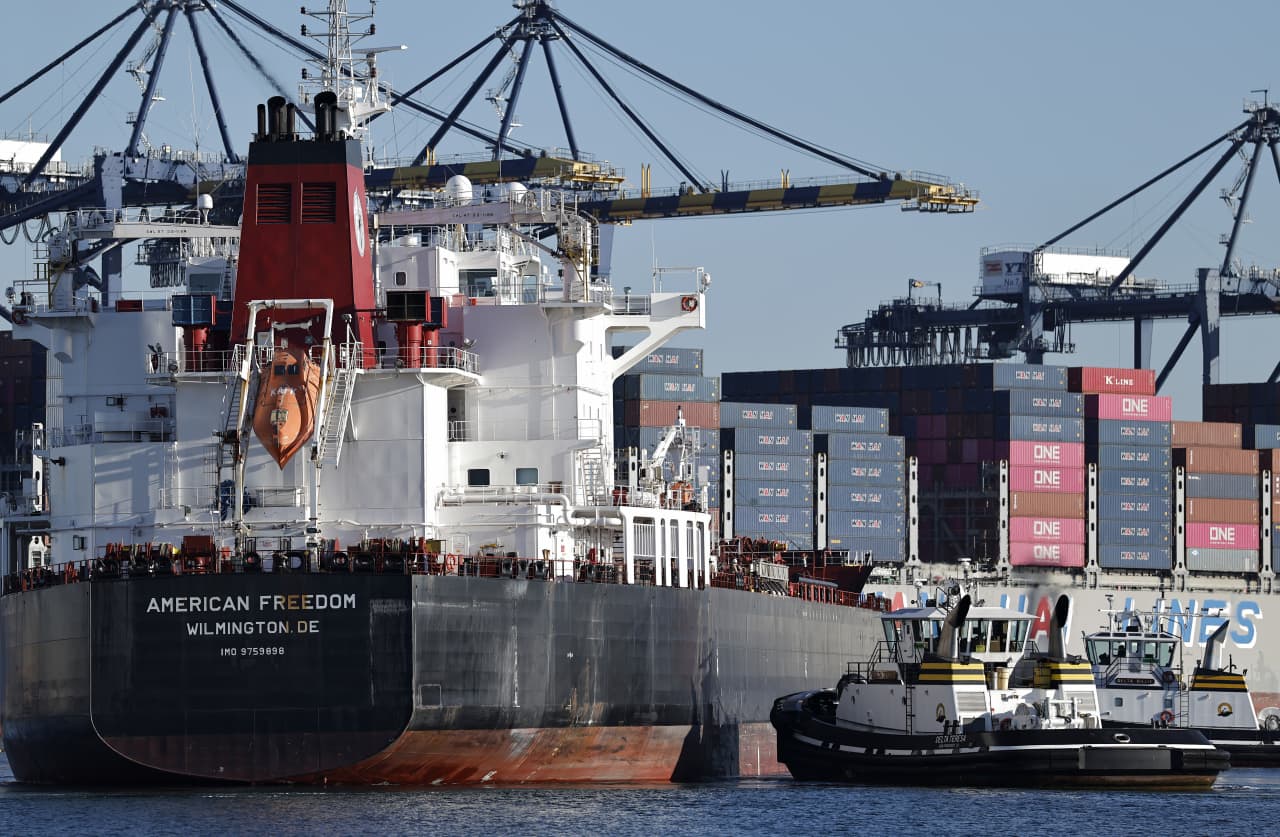
The U.S. is currently imposing a comprehensive naval blockade of Iran in retaliation for Tehran’s closing of the Strait of Hormuz, a narrow waterway connecting the Persian Gulf and the Gulf of Oman.
Compare 1 other version
ZeroHedgeThe blockade, which the U.S. had lifted for about three weeks while negotiations were being held in June and early July, is now back and effectively blockading Iran’s oil exports.
-
Brent crude, the international benchmark for oil, stood at approximately $94 a barrel on Thursday, which is about where the price stood at the same time last month when fighting resumed between the U.S. and Iran.
Compare 2 other versions
ZeroHedgeBrent Crude prices topped $91 per barrel this week amid heightened security concerns for shipping in the Middle East and fading hopes that the U.S. and Iran could return to negotiations.
CNBCBrent crude futures — the international price benchmark — rose 2.9% to reach $94.31 per barrel as of 7:55 a.m. ET. U.S. West Texas Intermediate futures for September delivery were 3.3% higher at $88.67 in morning trade.
-
Trump stated in an overnight Truth Social post that, with Tehran's military and military-industrial base reduced to "now rubble" and its "currency worthless," he will unleash severe economic consequences against "ANY country that allows its financial institutions, businesses, airports, or government entities to provide any type of lifeline to Iran."
Compare 3 other versions
BBC BusinessIn Wednesday evening's socal media post, Trump said he was launching "economic D-Day" on Iran because the Islamic Republic had failed to make a deal with the US.
CNBCThe Cabinet secretary's comments came hours after President Donald Trump declared that the U.S. plans to choke Iran's economy by levying major economic penalties against any country that provides "any type of lifeline" to Tehran.
Washington Times BusinessHis comments followed a similarly worded social media post by President Trump on Wednesday. Mr. Trump said there will be an “economic D-Day” coming soon and called on the U.S.’s allies to join the effort to “isolate, and defeat, the Iran threat.”
-
U.S. President Donald Trump insisted Tuesday that the strait was “open and operating” and posted a map depicting it as a U.S. territory. Iranian Deputy Foreign Minister Kazem Gharibabadi called him a “deluded man.”
Compare 1 other version
Common DreamsJust days after threatening to declare the Strait of Hormuz a US territory, President Donald Trump on Tuesday posted a map on his Truth Social platform with that label over the crucial waterway—and was swiftly called out by a top Iranian diplomat.
-
By Monday, a 60-day ceasefire deal expired, and neither side has signaled any progress on talks to end the war—which Trump claims is aimed at stopping Iran from building nuclear weapons, even though his own intelligence agencies have said it wasn't trying to do so. Trump notably ditched the Obama administration's Iran nuclear deal during his first term.
Compare 1 other version
BBC BusinessIt comes after a 60-day ceasefire with Iran expired on Monday, with no sign of a diplomatic or military off-ramp to the conflict that the US and Israel began at the end of February.
-
The oil price rise comes after the UAE said Wednesday it was halting all trade and financial transactions with Iran after the Gulf state said it had come under fire from the Islamic Republic on Tuesday.
Compare 2 other versions
MarketWatchOil prices rose on Thursday after President Donald Trump announced efforts to destabilize Iran’s economy.
Washington Times BusinessDUBAI, United Arab Emirates — The United Arab Emirates suspended all trade with Iran on Wednesday after the UAE said it had come under renewed fire from the country - a move that will further isolate the Islamic Republic, which is suffering under U.S. sanctions and a blockade.
-
Treasury Secretary Scott Bessent announced Thursday that the U.S. would impose some of the “toughest sanctions in history” on Iran next week, doubling down on the Trump administration’s economic warfare strategy as diplomacy stalls.
-
Mr. Trump added that diplomacy with Iran could happen “maybe at some point.” On Tuesday, he had insisted that the economic pressure campaign would continue and the White House had no plans to talk to the Iranians in the near future.
-
However, diplomatic momentum collapsed as Iran demanded that the U.S. break off its naval blockade and ease sanctions before the strait could be reopened.
-
Iranian officials are currently holding negotiations with Oman to hammer out a framework agreement for future control over the Strait of Hormuz. The pending plan, which was rumored to be in the final stages weeks ago, may outline specific routes for commercial ships to take to safely transit the passage.
-
Earlier this month, Iranian and U.S. officials indicated that the two sides were circling a deal that would reopen the Strait of Hormuz, establish a ceasefire and open the door to further technical talks.
-
The strait itself has become the center of nearly every conversation surrounding the war. For Iran, the waterway is key to its influence in the region after the war, with key ministers and security officials insisting that Tehran maintain significant control over the waterway.
8 details only one outlet reported
Independent claims that didn't surface elsewhere in our corpus. Treat as supplementary — not corroborated across outlets.
-
01 ZeroHedge Submitted by Tsvetana Paraskova Of OilPrice.com The reinstated U.S. blockade on Iranian oil exports is effectively preventing Tehran from exporting oil, making Iran’s oil volumes irrelevant for global oil market balances, Bob McNally, president of Rapidan Energy Group, told CNBC on Thursday.
-
02 Common Dreams 5 #000000 #FFFFFF The Iranian Parliament speaker said the strait will stay closed until the US blockade and oil embargo are lifted, and any party continuing its "aggression or threats" would face a "more severe defeat."
-
03 CNBC The Trump administration's plan to crush Iran's economy will likely negate the need for further U.S. military operations against the Islamic republic, Treasury Secretary Scott Bessent told CNBC on Thursday.
-
04 MarketWatch Futures Movers Oil prices jump after Trump declares economic war on Iran West Texas Intermediate and Brent crude’s front-month contracts both climbed after President Donald Trump said he was launching a “crushing economic operation” against Iran
-
05 Washington Times Business In an interview with CNBC, Mr. Bessent insisted that the incoming restrictions, which Treasury would announce on Monday, would cause the Islamic republic to “collapse.”
-
06 RealClearMarkets When President Trump announces yet another potential peace agreement with Iran, crude oil prices fall, and Americans make the mistake of thinking that gas and diesel prices will follow. But crude oil isn’t the right barometer of your pain at the pump. By the end of July, crude oil prices had fallen about 25 percent from their April peak, while gasoline prices dropped only about 9 percent after peaking at around $4.50 a gallon in May. Read Full Article »
-
07 Financial Times Trump announces new drive to isolate and crush Iranian economy UAE, long a crucial trading hub for Tehran, has also suspended commercial ties
-
08 BBC Business He wrote in all capital letters on Truth Social he was launching "the most crushing economic operation ever taken against any country!" He gave no further details, and did not name any other nation.
Fact Corroboration
Which sources independently confirm the same facts. Hover a claim to see its sources, or a source to see what it corroborates.
Coverage by Perspective
Source Similarity
Connections show how similarly each outlet covered this story. Thicker lines = more similar framing.
Sources (8)
- bbc-biz
- ft
- cnbc
- rcmarkets
- marketwatch
- commondreams
- zerohedge
- washtimes-biz