AI Data Center Expansion Drives Electricity Demand and Grid Concerns
-
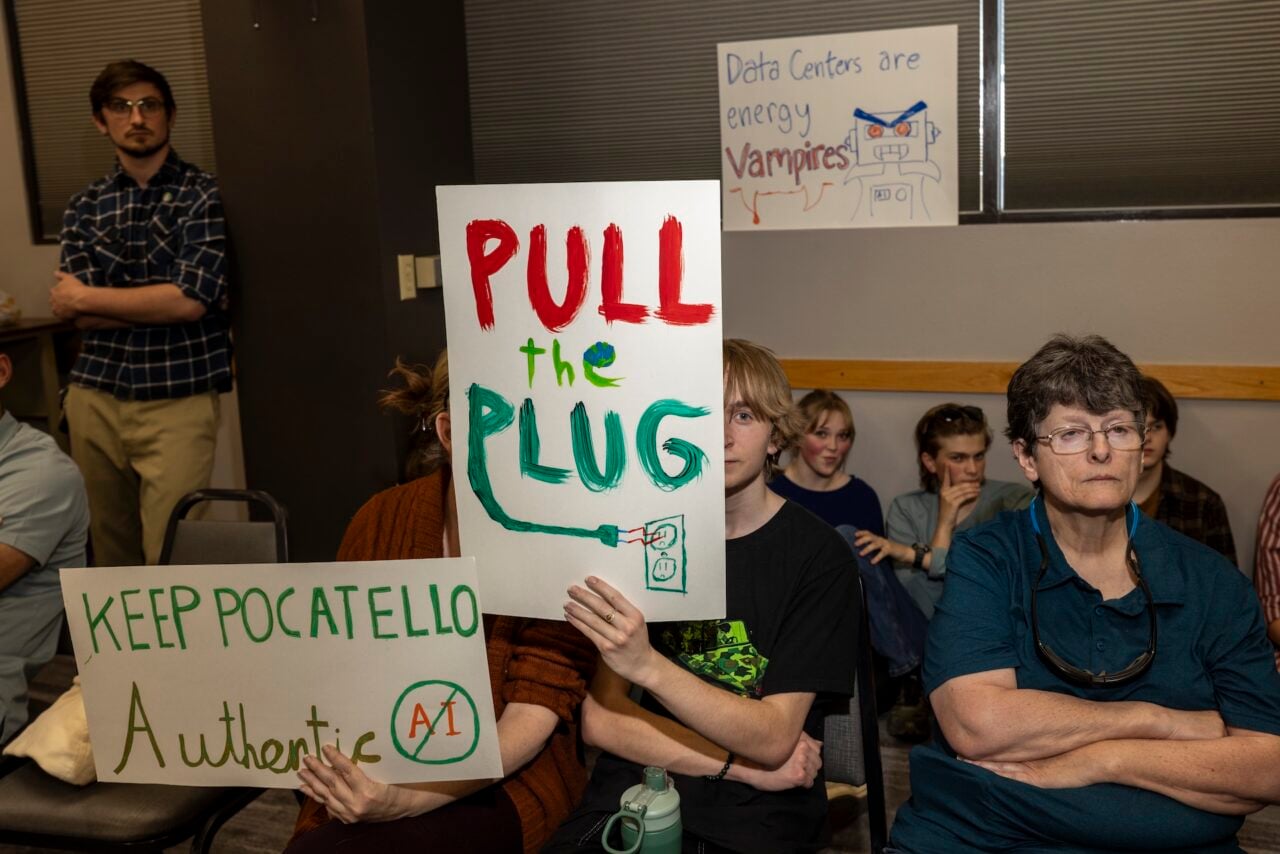
There's a growing backlash against the construction of local data centers, which consume massive amounts of electricity for compute and water for cooling in order to power artificial intelligence. According to a newly released Gallup survey, 7 out of 10 (71%) Americans oppose new AI data center construction in their area, with nearly half (48%) saying they're strongly opposed.
Compare 6 other versions
GizmodoOpposition to data centers has obviously become a big deal in recent years as the largest AI companies build their energy-sucking, water-hoovering monstrosities in communities across the United States. And Americans are frustrated with the lack of transparency that often comes along with having one in your backyard. For example, we recently learned about a data center in Fayetteville, Georgia, that guzzled 30 million gallons of water last year before it started paying a penny for the resources it was consuming.
The VergeAmericans do not want AI data centers in their backyards According to a new survey, data centers are unpopular with 71 percent of Americans, with water and electricity use a top concern.
EngadgetAI companies are spending astronomical sums of money on building data centers as quickly as possible in order to increase their compute power. But the majority of Americans don't want that infrastructure close to their homes, according to a Gallup survey.
TechCrunchAs data centers have proliferated, the general public has begun to push back against them, citing concerns over pollution, power prices, and water use. When Microsoft brings its own clean power to a project, it can plausibly say it has addressed two of those concerns. Without it, new data centers might be harder to sell to the public.
Ars Technica“Data centers are loud, ugly, and often drive up local electricity bills,” said Chris Lander, vice president of XFRA at SPAN, in correspondence with Ars. “[This] is quiet, discreet, and makes energy more affordable for the host and community.”
IEEE SpectrumThe power usage of these gigascale sites and their drastic, high frequency, abrupt load surges from the AI GPU clusters can trigger transient voltage events and frequency instability, risking the entire local grid. The grid itself is not robust enough to support these loads. This leads to the infrastructure gap: The utility is not robust enough and traditional backup sources, such as diesel generators and gas turbines, simply cannot react to millisecond-level power spikes in output. This will often force operators into a cycle of costly infrastructure over sizing just to buffer the volatility.
-
It added that “the current supply of capacity in PJM is not adequate to meet the demand from large data center loads and will not be adequate in the foreseeable future.”
Compare 1 other version
Gizmodo“The current supply of capacity in PJM is not adequate to meet the demand from large data center loads and will not be adequate in the foreseeable future. This is a simple factual issue,” the report explains.
-
The report comes on the heels of a white paper released by PJM Interconnection, which examined the future of the grid it operates. The white paper suggested three paths forward, but none of those appealed to one of the region’s largest utilities, AEP, which has threatened to leave the PJM grid altogether.
-
Gas-fired power generation in development globally rose by 31 percent in 2025. Almost a quarter of that added capacity is slated for the US, which has surpassed China with the biggest increase of any country. More than a third of that growth in the US is expected to directly power data centers, according to a recent analysis by the nonprofit Global Energy Monitor (GEM).
Compare 1 other version
TechCrunchBut as data centers grow in size and number, those same companies are turning to natural gas. Microsoft is included in that list; last month, the company said it was working with Chevron and Engine No. 1 to build a massive natural gas power plant in West Texas that could eventually generate up to 5 gigawatts.
6 details only one outlet reported
Independent claims that didn't surface elsewhere in our corpus. Treat as supplementary — not corroborated across outlets.
-
01 Gizmodo PJM Interconnection operates a wholesale electric power market in the mid-Atlantic, Midwest, and South that covers 67 million people in 13 states (Delaware, Illinois, Indiana, Kentucky, Maryland, Michigan, New Jersey, North Carolina, Ohio, Pennsylvania, Tennessee, Virginia, and West Virginia). That’s nearly 20% of the U.S. population, and it’s also an area with a lot of data centers.
-
02 TechCrunch Monitoring Analytics was direct that without rising demand from data centers, “the capacity market would not have seen the same tight supply demand conditions, the same high prices observed.”
-
03 CNET The data center race The data center race is driven by companies at the forefront of AI technology -- OpenAI, Microsoft, Google, Meta, Anthropic and others -- as they compete for control of the industry. For its part, Nvidia dominates the AI chip market, providing high-performance GPUs and CPUs that populate data centers.
-
04 Ars Technica The “distributed data center solution” announced by the San Francisco startup SPAN would deploy thousands of XFRA nodes that contain liquid-cooled Nvidia RTX Pro 6000 Blackwell Server Edition GPUs operating with minimal noise, according to a press release. By harnessing excess power capacity among US households, SPAN aims to quickly expand the available compute for AI workloads without the costs and delays associated with trying to build warehouse-sized data centers.
-
05 IEEE Spectrum At Data Center World 2026 in Washington, D.C., Ampace led a pivotal technical dialogue with Eaton during the session “Powering Giga-scale AI.” Their exchange unveiled a fundamental paradigm shift: To bridge the AI power gap, energy storage must evolve from a passive insurance policy into an active, high-speed stabilizer. By aligning Ampace’s semi-solid-state battery innovation with Eaton’s proven system intelligence, we are moving beyond simple backup to solve the physical paradox of the AI era.
-
06 The Verge From audacious plans to launch data centers into space to the latest legal battles over pollution, The Verge has the biggest news and reporting surrounding data centers.
Fact Corroboration
Which sources independently confirm the same facts. Hover a claim to see its sources, or a source to see what it corroborates.
Coverage by Perspective
Source Similarity
Connections show how similarly each outlet covered this story. Thicker lines = more similar framing.
Sources (7)
- techcrunch
- ieee
- gizmodo
- verge
- cnet
- arstechnica
- engadget