NASA's Nancy Grace Roman Space Telescope Set for Launch, Set to Explore Expanding Universe
-
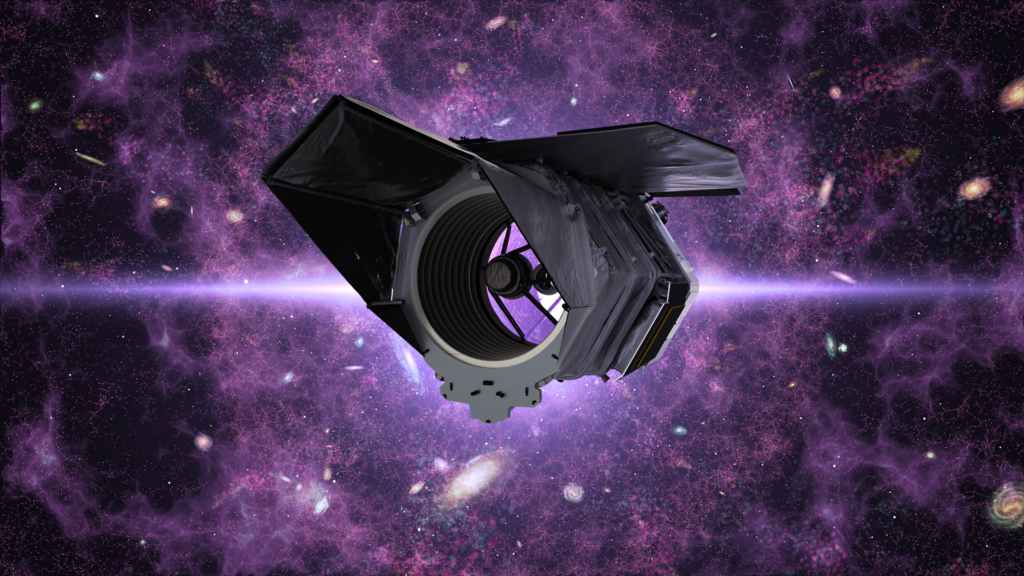
The $4.3-billion Nancy Grace Roman Space Telescope is scheduled for launch Aug. 30. Named for NASA's first chief astronomer, the observatory is expected to reveal new information about the expansion of the universe and discover multitudes of planets orbiting distant stars.
Compare 2 other versions
PBS NewsHourNASA is preparing to launch the Nancy Grace Roman Space Telescope. Here's what to know NASA plans to soon launch a new space telescope that will survey a billion galaxies to trace how the universe evolved over time, all courtesy of America's spy program and decades of research into detector technology. Once in position, it will take data that astronomers hope will help answer some of the field's most puzzling questions.
NBC NewsNASA on Sunday is set to launch a next-generation telescope into space that’s expected to survey hundreds of millions of stars and billions of galaxies. Its findings could also unlock clues about dark energy and dark matter, and some of the universe’s biggest enigmas.
-
Read more about NASA's Nancy Grace Roman Space Telescope After the Roman telescope launches, it’s set to spend more than three months journeying to its final destination, located roughly 1 million miles from Earth. The telescope is designed to live at a location in space known as L2, which is a Lagrange point, where the gravitational acceleration from the sun and Earth balance out, allowing the telescope to stay in a stable orbit. At L2, Roman should join another of NASA’s workhorse observatories, the James Webb Space Telescope, which launched in 2021.
Compare 1 other version
NPR NewsBefore it can do that, the Roman Space Telescope will have to get to its new home in the sky about a million miles away. Roman will live at the second Sun-Earth Lagrange point known as L2. There, the competing gravitational pulls of the Earth and the Sun help the telescope keep a steady orbit while using minimal fuel. The James Webb Space Telescope orbits at this point, which gives the spacecraft an unobstructed view of the sky.
-
Roman, as it is known to its friends, has an unusual history. About 15 years ago NASA was making plans to build a space telescope that could, among other things, search for exploding stars known as Type 1A supernovas. These supernovas were used as a kind of cosmological measuring stick to uncover a mysterious force called dark energy that was causing the universe to expand — a discovery that earned the Nobel Prize in 2011.
-
Three primary surveys are planned over the course of the Roman telescope’s mission. During the largest one, which will last over a year, the telescope will peer through the Milky Way’s dense, star-packed center, known as the galactic bulge, building a vast catalog of all the astronomical objects it observes.
Compare 1 other version
NPR NewsAnother goal of the telescope is to spend a month surveying all the stars in the Milky Way galaxy. Julie McEnery is Roman's project scientist. She says even though Roman has broadly the same sensitivity and sharpness of vision as the currently orbiting Hubble Space Telescope, its design lets it do things much faster.
3 details only one outlet reported
Independent claims that didn't surface elsewhere in our corpus. Treat as supplementary — not corroborated across outlets.
-
01 NPR News "It takes us a good three-plus months to get out there, and we're spending that time checking everything out and doing a whole bunch of calibrations and making sure everything is working the way we know it can," said NASA's Jeremy Perkins, an integration and test scientist on the mission. "It's basically like our time to kick the tires and just make sure that the focus is right, the pointing is right."
-
02 NBC News NASA will broadcast live coverage of the launch on its website and other platforms beginning at 6:20 a.m. ET.
-
03 New York Times Watch SpaceX Launch NASA’s Roman Telescope to Chart the Stars Astronomers will use data collected by Roman’s wide, deep gaze to study the dark universe and hunt for new worlds.
Fact Corroboration
Which sources independently confirm the same facts. Hover a claim to see its sources, or a source to see what it corroborates.
Coverage by Perspective
Source Similarity
Connections show how similarly each outlet covered this story. Thicker lines = more similar framing.
Sources (4)
- pbs
- npr
- nyt
- nbc