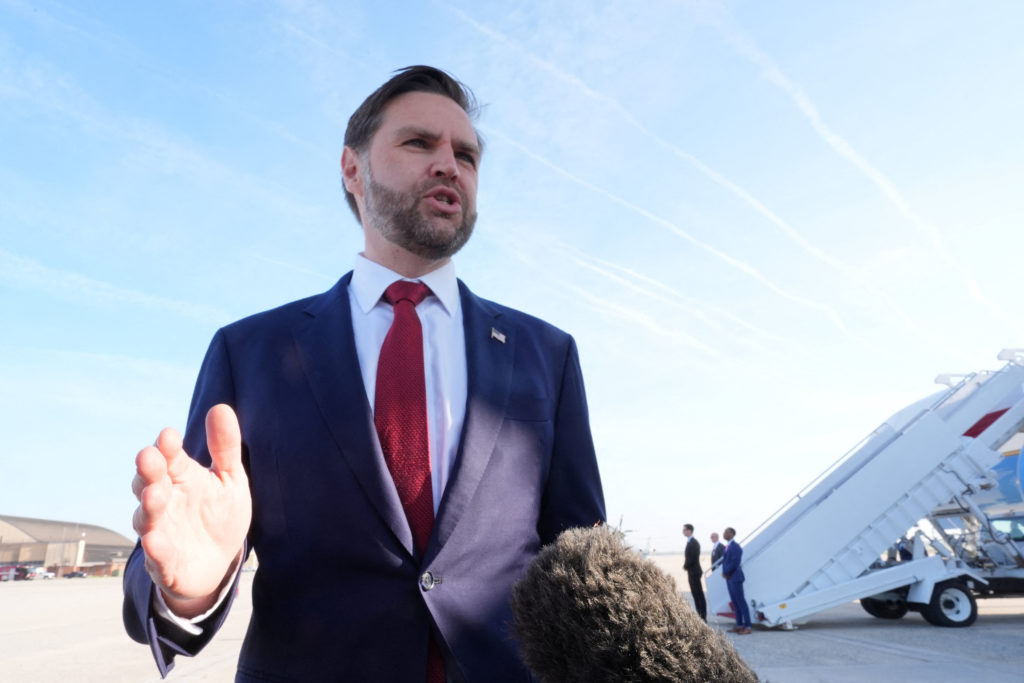
Vice President JD Vance Departs for Pakistan to Lead High-Stakes Iran Peace Talks Amid Shaky Ceasefire

Broke: Updated:
Vice President JD Vance Departs for Pakistan to Lead High-Stakes Iran Peace Talks Amid Shaky Ceasefire
Photo: PBS NewsHour

WASHINGTON — Vice President JD Vance departed Washington on Friday to lead a high-level U.S. delegation to Islamabad, Pakistan, for critical negotiations aimed at solidifying a fragile ceasefire and ending the ongoing conflict involving Iran, the United States, and Israel.

Vance, speaking to reporters before boarding Air Force Two, warned Iranian officials not to "play" the United States during what he described as a pivotal moment for the administration. Despite the warning, Vance expressed optimism regarding the outcome of the talks, stating that the U.S. delegation is proceeding with "pretty clear guidelines" from President Trump and expects a positive result.

The negotiations come as the war enters its sixth week, with a two-week-old truce showing signs of strain. "Ceasefires are always messy," Vance told the press, acknowledging that the current pause in hostilities often features "a little bit of choppiness." The Vice President emphasized that the U.S. approach is grounded in good faith but remains mindful of factions within the Iranian hierarchy that may obstruct a lasting agreement.

The U.S. delegation includes special envoy Steve Witkoff and Jared Kushner, the President's son-in-law. Their mission is to transform the temporary truce into a durable peace deal, a task that carries significant implications for President Trump's term and Vance's political standing as the administration's heir apparent.

The diplomatic push occurs against a backdrop of economic volatility. Reports indicate that inflation prices for March surged as the war spiked energy costs, adding urgency to the search for a resolution. Meanwhile, political pressure mounts as Democrats call for impeachment proceedings and Republicans debate domestic policy issues, leaving the Vice President to navigate complex international pressures.

In related developments, NASA's Artemis II astronauts are set to return to Earth on Friday following their mission around the moon. The successful landing marks a significant milestone for the space agency, occurring as the administration focuses its attention on resolving the geopolitical crisis in the Middle East.

The talks in Islamabad represent Vance's highest-profile moment to date as lead U.S. negotiator, testing his ability to bridge competing factions and deliver a diplomatic victory in a volatile region.

Coverage Analysis

The coverage of Vice President JD Vance's diplomatic mission to Islamabad reveals distinct editorial priorities that align with the political leanings of the source outlets, particularly regarding the framing of the conflict's urgency, the administration's internal dynamics, and the political stakes for Vance.

Framing of the Conflict and Urgency:

  • Lean Left (NYT, NBC): These outlets frame the narrative through a lens of instability and skepticism. The New York Times headlines emphasize 'New Deadline Looms' and 'Truce Wavers,' focusing on the fragility of the situation. NBC's coverage highlights Vance's historical skepticism of military intervention, subtly framing his current role as a pivot from past positions or highlighting the complexity of his diplomatic stance. The language centers on 'fractures' and 'wavers,' suggesting the peace process is already failing.
  • Lean Right (NY Post, The Hill): These sources frame the mission as a confident, high-stakes opportunity for success. Headlines like 'JD Vance expects ‘positive’ peace talks' and 'Vance optimistic for ‘positive’ discussions' utilize direct quotes to project certainty. The framing emphasizes the administration's 'clear guidelines' and Vance's proactive leadership, minimizing the chaos of the ceasefire to focus on the potential for a 'deal.'
  • Right (Breitbart): This outlet adopts a more combative, nationalist framing. By explicitly mentioning 'wreckers within Iranian hierarchy' and the 'pivotal juncture,' they frame the negotiations as a test of American resolve against internal enemies within Iran, rather than just a diplomatic exercise. The language is more aggressive ('wreckers') compared to the 'factions' or 'obstruction' terms used by center/left outlets.

Emphasis on Domestic Politics and Economic Impact:

  • Omission vs. Inclusion: The 'Lean Right' and 'Right' outlets (specifically The Hill and Washington Examiner) heavily emphasize the domestic political implications for Vance, framing the mission as a '2028 presidential race' test or an opportunity to position him as Trump's heir. The Hill explicitly links the diplomatic mission to 'inflation prices for March surged,' connecting foreign policy directly to voter pain points.
  • Center/Left Approach: The 'Lean Left' and Center outlets (NPR, PBS, AP) largely omit the 2028 political calculus in their headlines and lead paragraphs. Instead, they focus on the procedural aspects (the delegation members) or the immediate humanitarian/geopolitical stakes. The economic impact is mentioned in The Hill (Right) but treated as a background context rather than a primary driver of the narrative in Center/Left reporting.

Language and Sourcing:

  • Tone of Warning: While all outlets report Vance's warning to Iran not to 'play' the U.S., the context differs. Reuters and PBS present this as a standard diplomatic warning in a 'shaky' environment. The Hill and NY Post present it as a confident assertion backed by 'clear guidelines' from Trump, reinforcing the administration's strength.
  • The Artemis II Omission: A notable divergence is how the 'neutral' article integrates the NASA story. Lean Left (NYT) and Center outlets (NPR, PBS) give the Artemis II return equal weight in their headlines, treating it as a significant national achievement. The 'Lean Right' and 'Right' outlets (Breitbart, NY Post) completely omit the space mission in their headlines regarding Vance, prioritizing the geopolitical drama. This suggests a difference in what these outlets consider 'news'—national unity/achievement vs. geopolitical conflict.
  • Delegation Composition: The inclusion of Jared Kushner and Steve Witkoff is a key differentiator. The Hill (Right) explicitly details their presence to highlight the 'inner circle' nature of the deal-making, reinforcing a narrative of Trump's personal control. Center outlets mention them as part of the 'delegation' without the same emphasis on their specific political capital or relationship to Trump.

Why This Matters: The divergence in coverage shapes public perception of the mission's viability. Left-leaning sources prime readers to expect failure or complications ('messy,' 'wavers'), while Right-leaning sources prime them for a victory that will boost the Vice President's standing. The Center outlets provide a balanced but often more procedural view, focusing on the 'how' rather than the 'will it succeed.' The omission of the Artemis II story in Right-leaning coverage suggests a prioritization of conflict over achievement, while its inclusion by Left/Center outlets reflects an interest in broad national milestones.

Coverage by Perspective

Lean-Left
3
Center
8
Lean-Right
8
Right
2

Source Similarity

Connections show how similarly each outlet covered this story. Thicker lines = more similar framing.

Sources (13)

  • npr
  • washexaminer
  • rcp
  • reuters
  • washtimes
  • pbs
  • nbc
  • nypost
  • thehill
  • ap
  • nyt
  • usatoday
  • breitbart

Original Articles (21)

Lean Left Artemis II Astronauts Are Set to Arrive Home — New York Times
Right Vance Heads to Pakistan for Iran Negotiations at Pivotal Juncture in Ceasefire — Breitbart
Center Vice President JD Vance heads to Pakistan, signals optimism on negotiations - USA Today — USA Today
Lean Left Vance speaks before departing for negotiations with Iran — NBC News
Center WATCH: Vance warns Iran not to 'play' the U.S. as he heads to negotiations in Pakistan — PBS NewsHour
Center Vance warns Iran not to "play us" as he leaves for talks - Reuters — Reuters
Lean Right JD Vance expects ‘positive’ peace talks in Pakistan — with ‘clear guidelines’ for Iran — New York Post
Lean Right Vance optimistic for ‘positive’ discussions with Iran as he heads to Pakistan — The Hill
Lean Right Vance To Lead Negotiations at Expected Islamabad Trip — RealClearPolitics
Lean Right Live updates: Vance heads to peace talks; inflation surges as Iran war spiked energy prices — The Hill
Lean Right J.D. Vance warns Iran not to 'play us' as he departs for Pakistan-led talks — Washington Times
Lean Right Vance sent to negotiate with Iran as war’s future remains murky: Join Friday’s Whole Hog — The Hill
Center VP Vance to lead U.S. team in Iran peace talks. And, Artemis II to return to Earth — NPR News
Center Vance heads to Pakistan for talks to end the war between Iran, the US and Israel — NPR News
Lean Right Vance seeks to save fragile ceasefire at expected Islamabad trip — The Hill
Center Morning news brief — NPR News
Center Vance sets off to Pakistan to lead talks with Iran as war’s ceasefire remains shaky - AP News — Associated Press
Lean Right Iran peace talks give JD Vance an opening in 2028 race — Washington Examiner
Lean Left New Deadline Looms for U.S. and Iran as Truce Wavers — New York Times
Right Vance: U.S. Approaching Iran Negotiations With 'Good Faith', But Mindful of Wreckers Within Iranian Hierarchy — Breitbart
Center WATCH: Vance says 'ceasefires are always messy' — PBS NewsHour