Google Enhances Google Discover with AI Chatbot Features and Dedicated Student Hub
-
Google Discover is getting an AI chatbot-tuned feed You’ll soon be able to describe what you want to see in your Google Discover feed.
Compare 3 other versions
EngadgetSeparately, Google will soon begin rolling out an update to its Discover feed, which you can find in the Google app, Chrome and on Android, to allow you to curate the content it surfaces by conversing with the company's Gemini chatbot. Google will first release the update through its mobile app, where you'll find Gemini by tapping the three-dot icon next to any story. "Your feed will adjust on the fly, and remember your requests," says Google. I'm sure some people will find this feature useful, but it mostly feels like an attempt by the company to juice Gemini's usage numbers, so it can justify to investors its growing CapEx spending on AI infrastructure. Google already offers plenty of easy ways to shape your Discover feed if you don't find its default suggestions compelling.
ZDNetTo date, there've been limited options for customizing your Discover feed. You can tell Google that you want to see less content like that, say that you're not interested in that content at all, heart an article to show interest, or block a certain publisher entirely.
CNETStick with AI Mode in Google Search, and you can ask follow-up questions about the topic in question to dig deeper into a subject.
-
If you prefer to listen to the news rather than read it, Google is also making it easier to customize the audio briefings it offers through its News app on Android. "You can now curate your briefings by choosing specific topics, along with clear source attribution and links out to full articles, so you can more easily explore what matters most to you," says Google.
Compare 1 other version
The VergeGoogle announced a couple of other changes as well, including the ability to personalize daily audio briefings in the Google News app on Android.
-
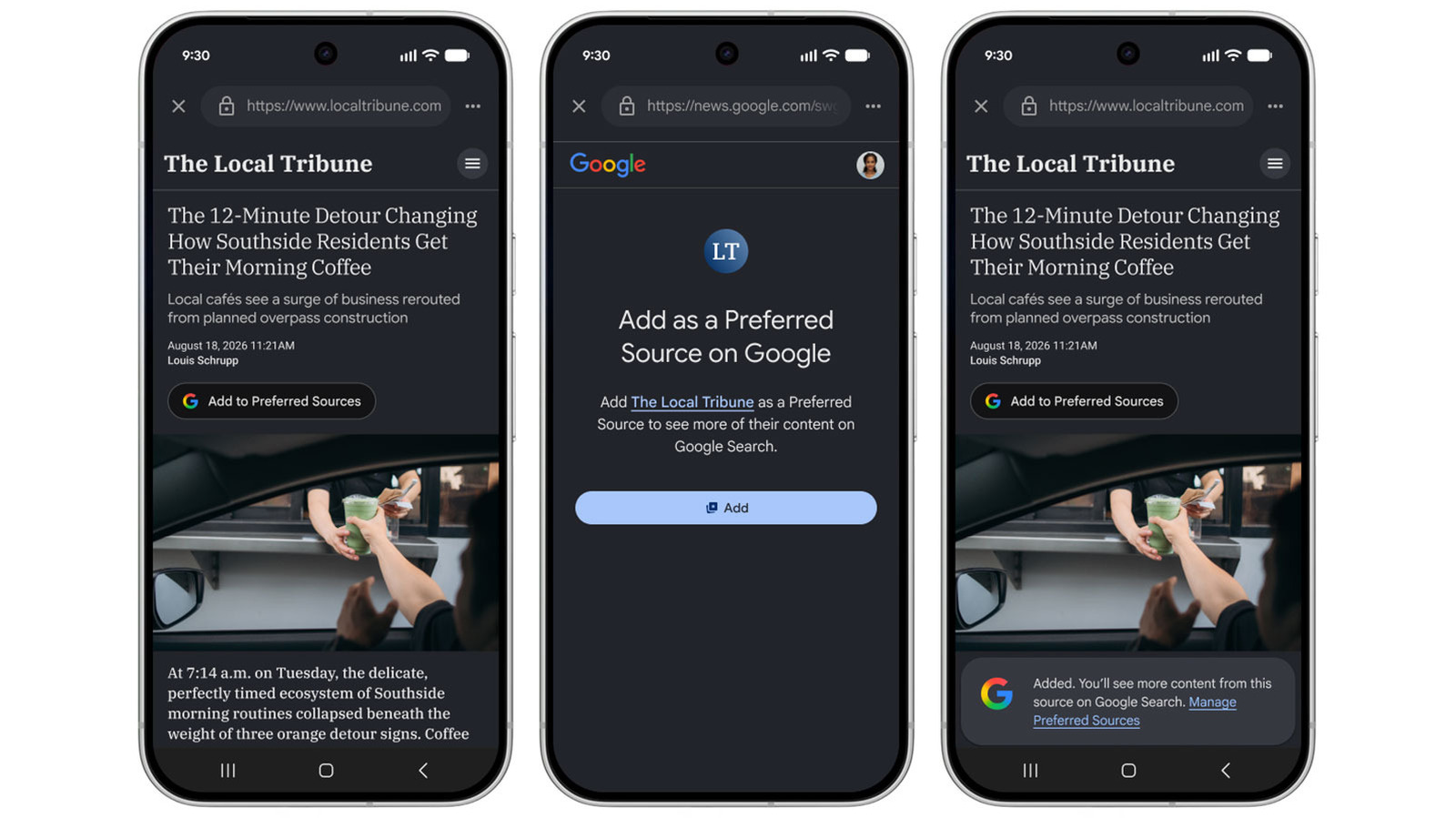
It's also adding Gemini to its Discover Feed. Google is making it easier for people to support their favorite publications by introducing a new "Preferred Sources" button webmasters can add to their websites. "When readers click this button, it adds the site as a Preferred Source on Google and immediately directs them back to where they left off on the publisher's page," Google explains. After clicking the button, you'll see the publication appear more frequently Google Search, including in Top Stories, AI Overviews and AI Mode.
Compare 1 other version
The VergeThere’s also an update to Preferred Sources, a feature that lets you see more of your favorite outlets across Search’s “top stories” section, AI Overviews, and AI Mode. With the change, publishers can place an interactive “Preferred Sources” button on their sites, which readers can select to quickly add it to their list without navigating away from the webpage.
-
As we’re gearing up for back-to-school season, Google is rolling out a new dedicated student hub in Gemini. It’s a one-stop repository for collecting research in a study notebook, creating flashcards, taking practice quizzes, and more. Google is also enhancing its study notebooks with support for graphs and images. It can even add test dates and deadlines to your Google Calendar based on your syllabus.
Compare 1 other version
CNETIt’s back-to-school season, and Google is getting in on the academic action. The company announced on Wednesday that a dedicated student hub, featuring a suite of AI study tools, will now be available on its Gemini AI assistant and through Google Search.
-
Google is also adding Deep Research to Gemini Live. You can ask Gemini to generate complicated research reports and talk through the results. If it’s taking a while, you can close the chat and lock your phone screen, and Gemini will let you know when your report is ready. In the coming weeks, it will also start rolling out a new feature for Lens in the Google mobile app that lets you take a photo of your study or worksheet and get explanations, help with complicated concepts, or even coaching if you’ve made a mistake.
Compare 1 other version
CNETA Google spokesperson didn’t immediately respond to a request for comment. Students will be able to ask Gemini to dig into a topic they’re researching and then switch tasks while the tool compiles the information in the background. When the report is finished, Gemini will send a notification and be available to discuss the report’s details and participate in a question-and-answer session to help the student better understand the findings.
-
Google is offering college students in the US a free year of Google AI Pro, which normally costs $20 per month. The plan includes four times higher usage limits in Gemini, access to Gemini Spark, Gemini features in apps such as Google Docs and Gmail, Google Health Premium and 5TB of storage.
Compare 2 other versions
The VergeEligible students in the US can score one year of Google AI Pro for free, which includes 5TB of storage, Google Health Premium, higher usage limits on Gemini, and access to Gemini across Google apps. Students outside the US will have to make do with the slightly less comprehensive Google AI Plus sub, which comes with 400GB of storage and lower Gemini usage limits.
EngadgetGoogle has a new promotion that gives students a full year of its AI Pro subscription for free. This typically costs $200 per year, or $20 a month, and the offer is available to eligible college students in the US.
3 details only one outlet reported
Independent claims that didn't surface elsewhere in our corpus. Treat as supplementary — not corroborated across outlets.
-
01 ZDNet The latter caught my eye, because it finally gives you much greater control over your Discover page than ever before.
-
02 Engadget The button formalizes something publishers, including Engadget, had been independently adding their websites for a while now. Even with referral traffic from Google declining in recent years due to products like AI Overviews and AI Mode, the company's search engine remains an important source of revenue for many media outlets. To that point, one has to wonder if Google is adding this feature now in attempt to appease at least some publishers. Facing pressure from the UK's Competition and Markets Authority, in June the company announced it would begin allowing websites to opt out of appearing in AI-generated search results. How much this latest measure actually helps publishers, if at all, will be instructive.
-
03 CNET Students will also be able to chat conversationally with Google Live regarding multi-step research papers to better understand the topic in question.
Fact Corroboration
Which sources independently confirm the same facts. Hover a claim to see its sources, or a source to see what it corroborates.
Coverage by Perspective
Source Similarity
Connections show how similarly each outlet covered this story. Thicker lines = more similar framing.
Sources (4)
- zdnet
- cnet
- verge
- engadget