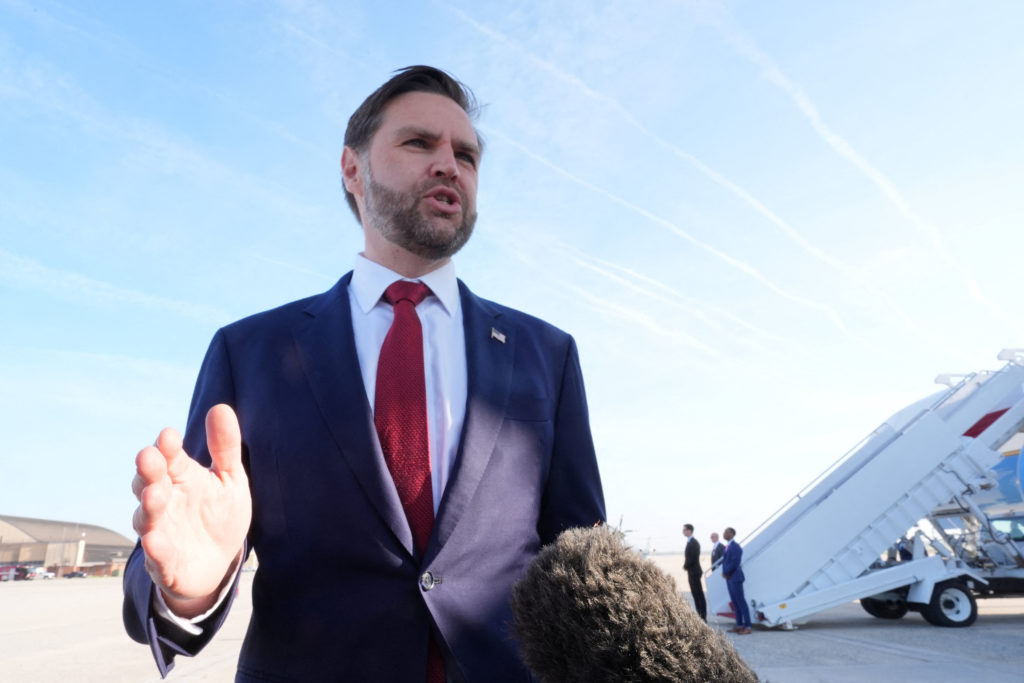
Vice President Vance Departs for Pakistan to Lead High-Stakes Iran Negotiations Amid Shaky Ceasefire

Broke: Updated:
Vice President Vance Departs for Pakistan to Lead High-Stakes Iran Negotiations Amid Shaky Ceasefire
Photo: PBS NewsHour

ISLAMABAD — Vice President JD Vance departed Friday for Islamabad, Pakistan, to lead a high-level U.S. delegation in critical negotiations with Iranian officials aimed at securing a lasting peace deal and solidifying a fragile two-week ceasefire. The talks represent the Vice President's highest-profile diplomatic mission to date, occurring as fractures emerge in the truce between the United States, Iran, and Israel.

Vance warned Iranian counterparts not to "play" the United States as he boarded Air Force Two, signaling a firm stance despite his expressed optimism regarding the potential for positive outcomes. "We're looking forward to negotiation," Vance told reporters before departure, noting that the U.S. delegation is proceeding with "pretty clear guidelines" from President Trump.

The negotiations come at a pivotal juncture for the administration and Vance's political future. As the war enters its sixth week, inflation prices surged in March due to energy market volatility linked to the conflict. The Vice President acknowledged the difficulties inherent in such diplomacy, stating that "ceasefires are always messy" and often feature "a little bit of choppiness."

The U.S. delegation includes President Trump's special envoy, Steve Witkoff, and senior advisor Jared Kushner. According to reports from The Hill, the group is tasked with converting the current temporary halt in hostilities into a durable agreement. Sources indicate that while the U.S. approaches the talks with "good faith," there is significant concern regarding factions within the Iranian hierarchy that may obstruct progress.

Reuters and other outlets confirm that Iran had requested negotiations with Vance, marking a significant shift in diplomatic engagement. However, the New York Times reported that fractures were already emerging in the limited cease-fire prior to Vance's arrival, raising questions about whether a deal can be reached before hostilities resume.

The stakes for the mission extend beyond immediate conflict resolution. The Washington Examiner noted that the talks offer Vance a rare opportunity to position himself as a dealmaker and bridge builder, potentially influencing his standing in the 2028 presidential race. The Hill described the mission as Vance's "biggest challenge yet," with heavy implications for the remainder of President Trump's term.

As Vance arrives in Islamabad, U.S. officials remain cautious but hopeful that the face-to-face talks will de-escalate tensions and prevent a broader regional war.

Coverage Analysis

The coverage of Vice President JD Vance's diplomatic mission to Pakistan reveals distinct editorial priorities that align with the political leanings of the source outlets, particularly regarding the framing of U.S. foreign policy success and domestic political consequences.

Framing of Diplomatic Agency and Success:

  • Lean Right (The Hill, Washington Examiner, New York Post): These outlets predominantly frame the mission as a strategic opportunity for Vance to demonstrate competence and secure a tangible victory. The language is heavily focused on 'dealmaking,' 'positive outcomes,' and Vance's role as a 'closer.' The New York Post and The Hill emphasize Vance's direct quotes about having 'clear guidelines' from President Trump, framing the mission as a top-down execution of a specific administration strategy rather than an open-ended negotiation. The Washington Examiner explicitly links the mission to Vance's 2028 presidential ambitions, framing the diplomacy through a domestic political lens of 'positioning' and 'legacy building.'
  • Lean Left (NYT, NBC): The framing here is significantly more skeptical and focused on fragility. The New York Times leads with the narrative of 'fractures' in the truce, suggesting that the mission is a reaction to failure rather than a proactive success. The language emphasizes 'uncertainty' and the 'waverings' of the ceasefire, implying that the diplomatic effort is fighting against inevitable collapse. NBC and NYT focus less on Vance's political future and more on the instability of the conflict itself.
  • Center (Reuters, AP, PBS): These outlets attempt a balance but lean into the 'high stakes' narrative. Reuters highlights the unusual nature of Iran requesting negotiations, framing it as a shift in diplomatic dynamics rather than just U.S. pressure. PBS and AP focus on the 'messiness' of ceasefires, using Vance's own quotes to ground the story in realism rather than optimism or pessimism.

Emphasis on Domestic Consequences:

  • Lean Right: There is a distinct emphasis on the domestic political fallout of the war, specifically regarding inflation. The Hill and Washington Examiner explicitly connect the 'sixth week' of war to surging energy prices, framing the diplomatic mission as an economic necessity for the administration's stability. This serves to validate the Trump-Vance approach by highlighting the tangible costs of inaction.
  • Lean Left: The domestic angle is less about economic metrics and more about the moral or strategic cost of the conflict. The omission of inflation data in the NYT summary suggests a focus on the geopolitical and humanitarian implications rather than market volatility.

Sourcing and Narrative Control:

  • Lean Right: These outlets rely heavily on Vance's direct quotes ('We're looking forward to negotiation') and the presence of key administration figures like Kushner and Witkoff to signal unity and strength. The narrative is one of a cohesive team executing a plan.
  • Lean Left: The sourcing emphasizes 'sources' and 'reports' that highlight internal friction. The NYT's mention of fractures emerging before Vance's arrival suggests a narrative where the administration is playing catch-up, contrasting with the Right's narrative of proactive leadership.

Omissions and Inclusions:

  • The 'Good Faith' Nuance: The mention of the U.S. approaching with 'good faith' while being mindful of 'wreckers within the Iranian hierarchy' (a point covered by Breitbart and included in the neutral summary) is a specific framing device used to preemptively blame Iranian obstructionism for potential failures. This allows Right-leaning outlets to maintain a narrative of U.S. benevolence and Iranian duplicity without needing immediate proof of failure.
  • The '2028' Factor: The explicit discussion of Vance's 2028 presidential prospects is almost exclusively found in Right-leaning sources (Washington Examiner, The Hill). Center and Left outlets omit this entirely, treating the mission as a foreign policy event rather than a political campaign stop.

Why This Matters: The divergence in coverage suggests that for Right-leaning audiences, the story is about competence and political capital (can Vance deliver a deal to help Trump's legacy?), while for Left-leaning audiences, the story is about risk and instability (is this diplomacy failing?). The Center outlets serve as a reality check, acknowledging the 'messiness' without the political spin. This fragmentation means that different segments of the public are consuming fundamentally different stories about the same event: one of a strategic victory in progress, and another of a fragile truce on the brink of collapse.

Coverage by Perspective

Lean-Left
2
Center
8
Lean-Right
9
Right
2

Source Similarity

Connections show how similarly each outlet covered this story. Thicker lines = more similar framing.

Sources (13)

  • npr
  • washexaminer
  • rcp
  • reuters
  • washtimes
  • pbs
  • nbc
  • nypost
  • thehill
  • ap
  • nyt
  • usatoday
  • breitbart

Original Articles (21)

Right Vance Heads to Pakistan for Iran Negotiations at Pivotal Juncture in Ceasefire — Breitbart
Center Iran wanted to negotiate with Vance. They got their wish - Reuters — Reuters
Center Vice President JD Vance heads to Pakistan, signals optimism on negotiations - USA Today — USA Today
Lean Left Vance speaks before departing for negotiations with Iran — NBC News
Center WATCH: Vance warns Iran not to 'play' the U.S. as he heads to negotiations in Pakistan — PBS NewsHour
Center Vance warns Iran not to "play us" as he leaves for talks - Reuters — Reuters
Lean Right JD Vance expects ‘positive’ peace talks in Pakistan — with ‘clear guidelines’ for Iran — New York Post
Lean Right Vance optimistic for ‘positive’ discussions with Iran as he heads to Pakistan — The Hill
Lean Right Vance To Lead Negotiations at Expected Islamabad Trip — RealClearPolitics
Lean Right Live updates: Vance heads to peace talks; inflation surges as Iran war spiked energy prices — The Hill
Lean Right J.D. Vance warns Iran not to 'play us' as he departs for Pakistan-led talks — Washington Times
Lean Right Vance sent to negotiate with Iran as war’s future remains murky: Join Friday’s Whole Hog — The Hill
Center VP Vance to lead U.S. team in Iran peace talks. And, Artemis II to return to Earth — NPR News
Center Vance heads to Pakistan for talks to end the war between Iran, the US and Israel — NPR News
Lean Right Vance seeks to save fragile ceasefire at expected Islamabad trip — The Hill
Center Vance sets off to Pakistan to lead talks with Iran as war’s ceasefire remains shaky - AP News — Associated Press
Lean Right Iran peace talks give JD Vance an opening in 2028 race — Washington Examiner
Lean Right How JD Vance became Trump’s ‘closer’ in Iran peace talks — Washington Examiner
Lean Left New Deadline Looms for U.S. and Iran as Truce Wavers — New York Times
Right Vance: U.S. Approaching Iran Negotiations With 'Good Faith', But Mindful of Wreckers Within Iranian Hierarchy — Breitbart
Center WATCH: Vance says 'ceasefires are always messy' — PBS NewsHour