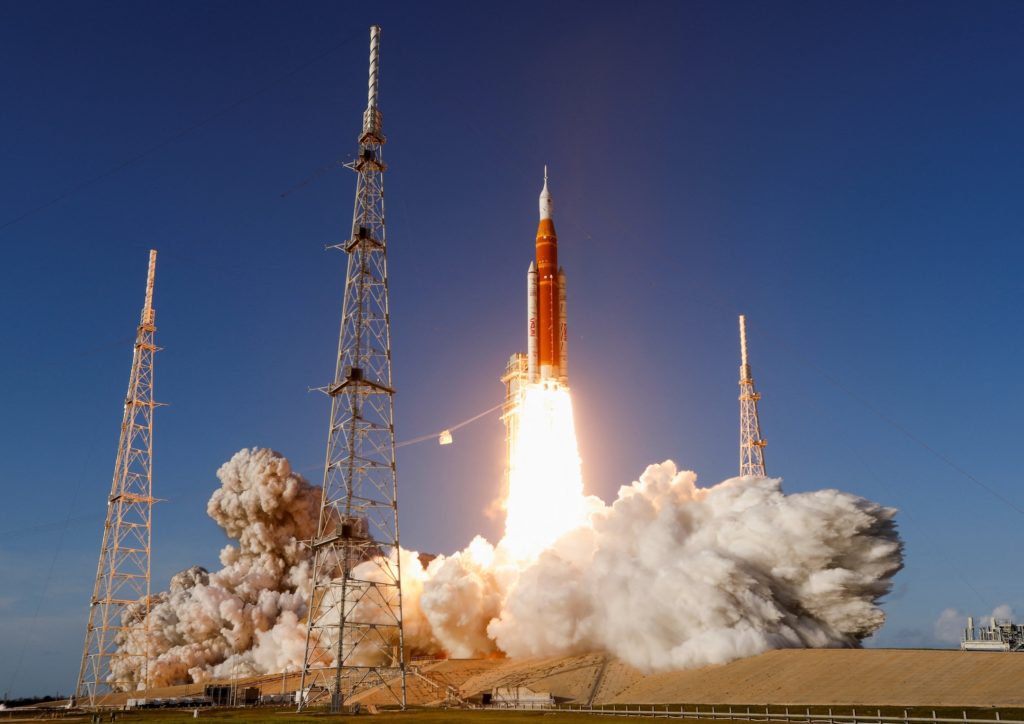
NASA successfully launched the Artemis II mission on Wednesday evening, sending four astronauts on a historic 10-day journey around the Moon. The launch marks the first time humans have traveled beyond low Earth orbit since the Apollo 17 mission in December 1972, ending a more than five-decade gap in crewed lunar exploration.
The mission lifted off at 6:35 p.m. ET from Kennedy Space Center in Florida, carrying a crew of three Americans and one Canadian aboard the Orion spacecraft. The astronauts—Reid Wiseman, Christina Koch, Victor Glover, and Jeremy Hansen of the Canadian Space Agency—are now in Earth's orbit before executing a translunar injection burn to begin their voyage toward the Moon. The crew has named the spacecraft "Integrity."
The Artemis II mission is a critical test flight designed to validate the Space Launch System (SLS) rocket and Orion capsule in deep space. While the crew will not land on the lunar surface, they will travel approximately 250,000 miles from Earth, venturing farther into space than any humans have ever been. The mission is intended to pave the way for a future lunar landing scheduled for 2028.
"A new era has really started," said former NASA astronaut Mike Massimino, analyzing the launch for NBC News. The event drew large crowds to Cape Canaveral and Titusville, Florida, as well as spectators watching from commercial aircraft. Footage captured by passengers aboard a flight showed the rocket ascending against the evening sky.
President Donald Trump, who had previously pledged to return astronauts to the Moon, celebrated the launch as evidence of American leadership in space. "The United States is winning, in Space, on Earth, and everywhere," Trump said ahead of the launch. The mission also drew attention to the growing space competition with China, which is pursuing its own lunar program with significant focus.
Shortly after launch, the crew reported a technical issue with the Orion spacecraft's Universal Waste Management System, commonly known as the toilet. The problem was resolved overnight following troubleshooting by NASA controllers in Houston and adjustments made by the astronauts, according to reports from The Associated Press and USA Today. The crew has since confirmed that all systems are functioning correctly.
The Artemis II mission represents a significant technological milestone, testing life support systems, radiation shielding, and navigation capabilities required for future deep space exploration. The crew is expected to reach the vicinity of the Moon by Monday night, where they will conduct various tests before returning to Earth.
The launch has been described by officials and observers as a unifying moment for the United States, occurring amidst domestic political divisions. However, some experts have noted the inherent risks of deep space travel. "Off by an inch, you're in big trouble," one expert told The New York Post regarding the challenges of the mission.
The Artemis program aims to establish a sustainable human presence on the Moon, utilizing it as a gateway for future missions to Mars. The success of Artemis II is seen as the first major step in this long-term strategy, with subsequent missions planned to test lunar landing systems and surface operations.