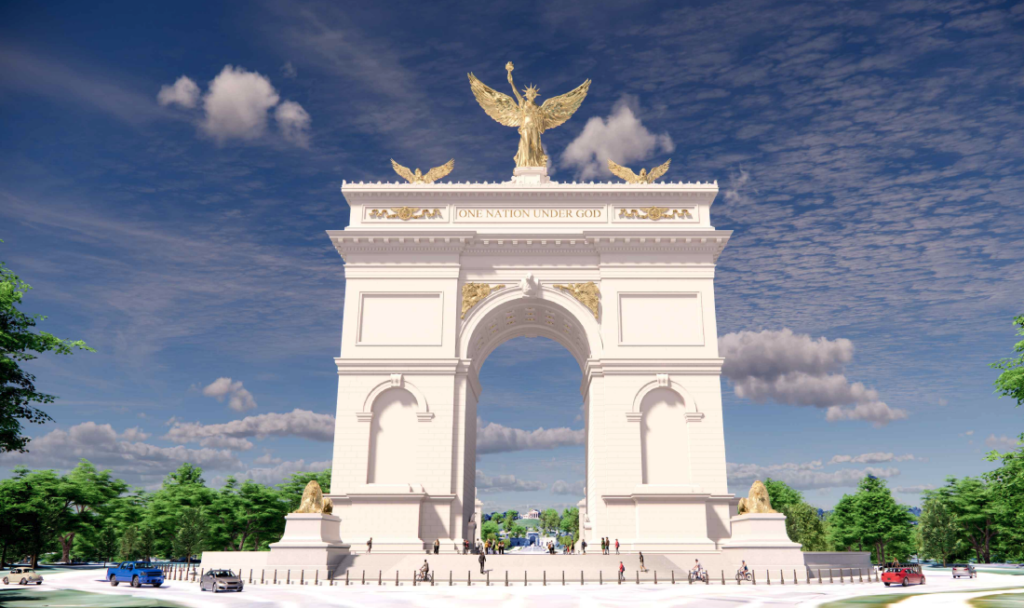
The coverage of the proposed 'Arc de Trump' reveals a sharp divergence in framing based on political alignment, primarily driven by the choice of nomenclature, the context provided for the project's timing, and the selection of descriptive adjectives. While all outlets report the same physical specifications (250 feet, Lady Liberty figure, specific inscriptions), their editorial choices construct distinct narratives: 'Lean Left' outlets frame the project as a controversial legacy play, 'Center' outlets focus on the aesthetic and bureaucratic process, and 'Right-leaning' outlets emphasize patriotic symbolism and administrative momentum.
Skepticism and Satire
The Guardian US explicitly uses the pejorative term 'Arc de Trump' in its headline and body, immediately framing the project as a personal vanity project rather than a national monument. It describes the initiative as a 'legacy-building quest,' implying self-aggrandizement.
NBC News and the New York Times use neutral-to-descriptive language but contextualize the project within a 'second term' and 'imprint,' subtly highlighting the political ambition behind the design.
The emphasis is on the scale and the specific location (across from Lincoln Memorial) to suggest a visual competition with existing historical icons.
By adopting the nickname 'Arc de Trump' and using words like 'quest,' these outlets signal to readers that this is a political stunt, inviting skepticism about its merit and appropriateness.
Descriptive Neutrality
USA Today, PBS NewsHour, and the Associated Press avoid loaded nicknames entirely, referring to it as a 'Triumphal Arch' or 'Washington triumphal arch.'
The AP and PBS focus heavily on the visual inventory (gilded eagles, lions, winged figure) without attaching political judgment to the design choices.
The narrative is driven by the procedural aspect: the upcoming vote by the Commission of Fine Arts.
This approach treats the story as a matter of public record and design review, prioritizing factual accuracy over political interpretation. It allows the visual absurdity or grandeur to speak for itself without editorial guidance.
Patriotic Symbolism and Momentum
The Washington Examiner and Fox News lead with the specific inscriptions ('ONE NATION UNDER GOD'), framing the arch as a celebration of American values rather than a personal monument.
The Washington Times and New York Post mention the halted ballroom project, but frame it as a 'setback' from which the administration has moved forward with determination ('has proceeded,' 'unveils new renderings').
Language focuses on the grandeur ('massive,' 'dwarfing') and the specific patriotic iconography (Lady Liberty, eagles) as positive attributes.
By highlighting the religious and patriotic text and framing the project as a resilient continuation of administration goals despite legal hurdles, these outlets validate the project's legitimacy and appeal to conservative values.
The Nickname
USA Today
PBS NewsHour
Associated Press
Fox News
The Guardian US
NBC News (in body)
Omitting 'Arc de Trump' prevents the reader from immediately categorizing the project as a joke or vanity, while using it reinforces that categorization.
The Ballroom Setback
NBC News
New York Times
The Guardian US
Washington Post (implied context in source list)
New York Post
Washington Times
Right-leaning outlets use the ballroom ruling to highlight a narrative of 'administrative resilience'—the administration is pushing forward despite judicial pushback. Left-leaning outlets omit this, likely to avoid validating the narrative of a 'siege mentality' or focusing on the legal controversy.
The Inscriptions
Associated Press (in headline)
NBC News
Washington Examiner
Fox News
Right-leaning outlets prioritize the 'One Nation Under God' text, signaling that this is a moral/religious statement. Center and Left outlets mention it as a design element but do not lead with it, treating it as one of many features.
The divergence in coverage is not about the facts of the design (which are consistent across sources) but about the intent attributed to the President. Left-leaning coverage frames the arch as an act of ego and political posturing, Center coverage treats it as a bureaucratic design review, and Right-leaning coverage frames it as a patriotic reclamation of national symbols. These framing choices dictate how the reader interprets the scale and location: as an insult to history (Left), a design challenge (Center), or a bold statement of national pride (Right).